ICP
  • About
    • ICP for Programs, Financiers, and Green Banks >
      • GHG Accounting
      • Adaptive Reuse
      • Certification Timing
      • Post-Cert Changes
    • How Does ICP Work? >
      • Project Framework
      • Roadmap to IREE Certification
    • GGRF EPA Reporter
    • Tech Forum >
      • Technical Forum Blog
      • Discussion Notes
      • Call Recordings
      • Reference Documents
      • Glossary
      • Acronyms
      • Protocol Archives
    • ICP in Canada
    • Contact Us
  • Training
  • IREE Certification
    • Guide to IREE Certification
    • Commercial Protocols >
      • Large Commercial
      • Standard Commercial
      • Targeted Commercial
      • Basic / Performance
    • Multifamily Protocols >
      • Large Multifamily
      • Standard Multifamily
      • Targeted Multifamily
      • Basic / Performance
    • Project Development Specification
    • Project Registration >
      • Performance Update
    • Tools and Templates >
      • Cx, O&M, M&V Templates
      • QA Checklists
      • Building Button
    • Case Studies
  • Providers
    • Project Developer Network >
      • Join the ICP PD Network
    • Quality Assurance Assessors >
      • Join ICP's Quality Assurance Asserssors
  • Blog
    • Blog
    • ICP In the News

ICP Protocols Updated to Version 2.2

4/22/2025

Comments

 
Picture
The Investor Confidence Project (ICP) is pleased to announce the release of version 2.2 of its ICP Protocols. This latest update reflects our ongoing commitment to refining and enhancing our standards to better serve the energy efficiency industry. Version 2.2 incorporates valuable feedback from market participants and aligns with the latest industry practices, ensuring that our protocols remain both practical and forward-looking.
​
Key enhancements in version 2.2 include updated technical requirements, streamlined documentation processes, and clarified performance measurement and verification guidance. These improvements reduce project development time, enhance transparency, and increase investor confidence in energy efficiency projects. By integrating insights from diverse stakeholders, we have ensured that the protocols are robust and adaptable to various project types and scales.
​
We invite all stakeholders—project developers, investors, and energy service companies—to review the updated protocols and provide feedback. Your input is crucial in our mission to standardize energy efficiency projects and unlock investment at scale. For more information and to access the updated protocols, please visit  www.eeperformance.org. Access the latest protocols in the IREE Certification dropdown, and track changes housed in your Technical Forum.

Comments

ICP Launches Methods for Adaptive Reuse

11/13/2024

Comments

 
Picture
The Investor Confidence Project (ICP), a part of GBCI, announces the launch of its Adaptive Reuse Addendum, a critical expansion of the ICP system. This new addendum addresses the growing need for tools that facilitate energy efficiency retrofits in projects lacking historical energy data, such as converting commercial properties into residential spaces.

As cities recover from the pandemic and remote work trends persist, office buildings and other commercial spaces are increasingly underutilized. Adaptive reuse, particularly converting commercial properties into housing, has emerged as a crucial strategy to meet housing demand and reduce greenhouse gas emissions. This addendum aims to help project developers, investors, and building owners repurpose these buildings, even when traditional energy baselines are unavailable.

The benefits of adaptive reuse are wide-ranging: reducing waste, preserving historical and cultural landmarks, and fostering community revitalization, all while addressing the urgent housing shortage. This is especially relevant in high housing demand regions, where new construction has not kept pace with population growth. As a result, cities and developers are increasingly embracing adaptive reuse as a critical tool to meet sustainability goals, mitigate climate impacts, and increase housing supply.

By broadening the ICP IREE certification to these evolving asset categories, the Adaptive Reuse Addendum establishes a standardized approach for gut rehabs and changing use cases. It helps project developers, building owners, and programs unlock the potential of buildings transitioning between commercial and residential uses. This brings sustainability to the forefront of adaptive reuse efforts and ensures stakeholders' financial benefits.

Visit www.eeperformance.org for more information on the Adaptive Reuse Addendum and how it can help streamline investment in energy-efficient retrofits.

Comments

ICP Launches GHG Accounting Methods

11/7/2024

Comments

 
Picture
The Investor Confidence Project (ICP) is proud to announce the launch of a new approach to measuring the greenhouse gas (GHG) impacts of building retrofit projects. This new GHG guidance empowers utilities, financiers, government agencies, companies, and portfolio owners to project GHG reduction goals in alignment with environmental, social, and governance (ESG) objectives.

ESG investments continue to grow in 2024, with global ESG assets projected to reach $33.9 trillion by 2026, representing over 20% of total assets under management, according to PwC's Asset and Wealth Management Revolution 2022. The rapid expansion in ESG investments reflects the increasing demand for accountability and sustainable practices across industries, driven by corporate commitments and investor pressure.

Historically, energy efficiency projects have focused on energy savings and financial returns. However, ICP’s new approach enables stakeholders to evaluate the carbon emissions of projected building retrofit investments. 

GHG impacts can be tracked monthly or hourly through smart meter data, helping optimize retrofit strategies by targeting peak grid hours with the highest GHG intensity. This innovation can increase GHG reductions, particularly for commercial buildings where energy use often coincides with high-emission periods.

Benefits for ESG-Driven Organizations
ICP’s new GHG conversion standard offers investors and building owners a step-by-step process to define the appropriate GHG metrics for their goals. It also establishes clear guidelines for ensuring that projects are measured accurately regarding energy savings and their GHG impact, utilizing widely available grid and meter data. This provides a clearer understanding of how building projects contribute to ESG performance.

A Shift from Energy to GHG Impacts
This new approach marks a significant shift at ICP, expanding the focus from energy efficiency to GHG optimization, a growing priority for organizations seeking to meet aggressive carbon reduction targets. The European Union’s commitment to deforestation-free commodities by the end of 2024 is just one example of the regulatory pressures pushing investors and corporations to accelerate their sustainability efforts. ICP’s GHG conversion factor aligns with this momentum, offering the tools to meet emerging global standards while advancing meaningful climate action.

To learn more and access the new ICP GHG method, visit: https://www.eeperformance.org/ghg-accounting.html

About the Investor Confidence Project (ICP)
The Investor Confidence Project is dedicated to increasing investor confidence in energy efficiency projects by standardizing how projects are developed, documented, and measured. ICP’s protocols reduce transaction costs, improve reliability, and promote greater market participation by enabling predictable outcomes for building energy efficiency investments.


Comments

Creating an asset class for efficiency

5/29/2024

Comments

 
Author: Matt Golden
Picture
Investor Ready Energy Efficiency (IREE) certification offers a groundbreaking approach to energy efficiency by establishing a standard asset class for commercial retrofits. Standardization is crucial for defining how building retrofit projects are developed, engineered, and implemented and how their performance is measured.  Green Business Certification Inc. (GBCI)’s IREE certification aligns existing industry-accepted technical standards into a standardized project development and quality assurance process to ensure that energy efficiency projects are consistent and adhere to high performance
and impact criteria.

Why standardization is critical

For the energy efficiency market to scale and attract meaningful private investment, there needs to be a shift away from the current bespoke approach to project development. Idiosyncratic project development and quality assurance processes pose substantial barriers to financing, requiring extensive engineering time and individual due diligence. This results in high transaction costs and prevents the efficient bundling of projects, a necessary step for securitization and risk management.

Drawing from the success seen in solar energy, mortgage-backed securities, and auto loans, it is evident that standardizing underlying assets is a crucial enabler of growth for financial markets. The solar, mortgage, and auto loan markets have all benefited from consistent understanding and standardization that enables efficiency; for instance, the securitization process that propelled the solar industry's growth relied on standardizing project documentation and third-party certifications. Similarly, the market for mortgages and auto loans thrived on a consistent asset definition that streamlined underwriting and enabled the bundling of loans. Standardization across these asset classes facilitated efficient capital allocation and attracted secondary market participants who could have confidence in project underwriting and investment risk profiles. As the demand for decarbonization efforts skyrockets globally, the energy efficiency retrofit market will require such standardization. 

The role of federal investments and the need for private capital

With $20 billion of Inflation Reduction Act funds being invested into non-profit financial institutions for decarbonization projects, there's a pressing need for projects that deliver tangible results, are cost-effective, and are appropriately evaluated for risk.

Standardization through IREE certification will support these institutions in identifying projects that meet these criteria. Doing so, IREE will make energy efficiency projects more attractive to private investors by lowering transaction costs and providing a clear framework for assessing and managing risks. This will realize the larger vision of the IRA,  attracting the large-scale private capital crucial for sustainable growth in the building retrofit market. 

A call for standardization in energy efficiency

As the United States moves towards significant decarbonization of its building stock, the need for a standardized approach in the commercial energy efficiency industry cannot be overstated. IREE certification is more than just a certification; it's a crucial underpinning for creating a scalable, investable market. By drawing lessons from other asset classes, it's clear that standardization is the key to unlocking trillions of dollars in capital necessary for this transformation. We expect the industry's adoption of standardized tests to drive a surge in investments and realize growth in energy
efficiency projects nationwide.

Comments

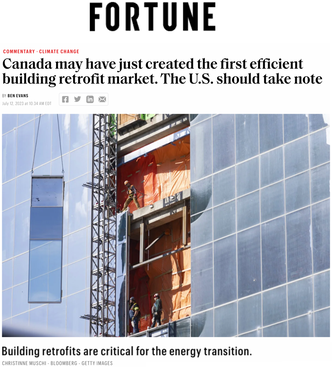
Canada may have just created the first efficient building retrofit market. The U.S. should take note.

7/20/2023

Comments

 
Picture
Author: Ben Evans
​This article was originally featured in Fortune on July 12, 2023. Read the original article here.

Following the commitments of governments, corporations, and institutions, billions in funding have been allocated to build a net-zero carbon economy by 2050. In the U.S., the Inflation Reduction Act (IRA) alone includes an estimated $369 billion in energy and climate provisions. These commitments represent an enormous challenge and opportunity to target critical barriers to meaningful greenhouse gas emissions reductions, which means we must not overlook our existing buildings.


While many sectors of the U.S. economy are reducing emissions, the buildings sector is a major exception, largely due to aging existing buildings. Homes and buildings account for 40% of U.S. energy consumption and at least 30% of U.S. greenhouse gas emissions–more than any other sector of the economy.


Of the country’s roughly 6 million commercial buildings, 75% are more than 20 years old. Given that these buildings will be in use for decades to come, they must be retrofitted to achieve the world’s climate commitments. The International Energy Agency estimates that we need to retrofit 20% of global building space by 2030 to meet emissions targets, or 2.5% of building space annually.
Smart policy and program design can offer a path to realizing both commercial and residential retrofits at a rapid pace.


Earlier this year, the U.S. Environmental Protection Agency (EPA) announced the initial program design of its $27 billion Greenhouse Gas Reduction Fund, a key climate financing initiative in the IRA. Over $19 billion of the fund will flow to nonprofit grantees, which will then allocate the funds to community financing institutions, such as green banks, community development finance institutions, and credit unions to invest in projects that lower pollution and energy costs.

The EPA rightly identified building efficiency improvements as one of three priority areas for funding. And as the agency moves closer to putting money on the street, it would be smart to look closely at a program implemented by our neighbors to the North that has successfully streamlined and accelerated similar investments in retrofit projects.


In 2020, Canadian Prime Minister Justin Trudeau announced a $2 billion investment in large-scale building retrofits as part of a national growth plan that would be funded by the Canada Infrastructure Bank. Since the announcement, the bank quickly ramped up a Building Retrofits Initiative to execute these investments. As of March 2023, the initiative has made $900 million in building efficiency investment commitments.


The bank’s unique approach provides a model for how public funds in the U.S. can be deployed into retrofit projects at the pace and scale required to move the needle on climate targets. By tying interest rates directly to carbon emissions reductions, the bank’s program incentivizes investment in projects with the greatest potential for climate impact, pushing funding to projects that deliver strong results.
The model used by the bank also brings standardization to predicting and documenting the potential energy savings associated with retrofit investments, overcoming complexity and bureaucracy that have historically been major barriers to investing in building efficiency at scale.


Today, it is typical for investors to utilize their own idiosyncratic approaches to predict and document project energy savings. This market fragmentation makes assessing project returns costly and evaluating project risks difficult. These challenges are compounded when operating an initiative responsible for deploying $2 billion.


To overcome these challenges, the Canadian retrofits initiative turned to Investor Ready Energy Efficiency (IREE) certification. Originally developed by the Environmental Defense Fund and now administered by Green Business Certification Inc. (GBCI), IREE provides third-party verification that the estimated savings associated with a proposed retrofit project have been determined and documented following industry best practices.


IREE certification enables the Canada Infrastructure Bank to partner with firms across the country that can develop and bundle retrofit projects at scale. It also makes underwriting the performance of these otherwise unique investment opportunities easier. The result is more potential projects sourced and evaluated at a lower cost. By uniting all its partners under a common framework, the Canada Infrastructure Bank is moving the retrofit market a step closer to the standardization that is common in other more efficient markets, such as those for mortgages, car loans, and solar power purchase agreements.


This article excerpt was originally featured in Fortune on July 12, 2023. Read the full article here.


Comments

EcoGreen Solutions halves costs through the Investor Confidence Project

7/28/2021

Comments

 
​GBCI administers the Investor Confidence Project (ICP), and its Investor Ready Energy Efficiency Certification (IREE). ICP is a global underwriting standard for developing and measuring energy efficiency retrofits for commercial and multifamily residential buildings. Through its IREE certification, ICP aims to standardize energy efficiency upgrades.

“IREE certification was introduced to us as an alternative pathway to access PG&E’s zero percent on-bill financing (OBF) program,” says Corey Brophy, Director of Programs and Processing at EcoGreen Solutions. “So that’s what I initially saw the certification as, an alternative requirement, and additional compliance cost. I couldn’t have been more wrong.” 

Corey elaborated on the IREE incorporation process for their company and the differences they've seen as a result:
EcoGreen Solutions is an energy services firm that has helped thousands of organizations cut costs through energy-efficiency improvements since its founding in 2007. When the firm began following the IREE protocols for PG&E’s OBF program, they quickly realized that using the protocols as a standardized process for developing all projects would allow their team to reach many more customers. 

“IREE provides a recipe that standardizes the entire project development process. So, we jumped at the opportunity to engrain this standardization into our business model,” explains Corey.  

​Embracing IREE protocols fully enabled EcoGreen Solutions to break the development process into a precise series of ten to fifteen-minute tasks. “What took thirty to forty hours of a professional engineer's time now takes nine hours,” continues Corey. You can imagine the impact that has on profitability.” 

Not only did the embrace of IREE substantially reduce project costs, but the time savings also allowed EcoGreen Solutions to more than double the number of energy-efficiency projects they complete each year. ​
Picture
EcoGreen project highlights a side-by-side LED and Metal Halide comparison, which creates 15% more light on the ground.
The benefits of IREE go beyond improved efficiency and output. With standardization comes consistency and quality. Each IREE project is vetted through a rigorous quality assessment and third-party certification process. This gives project financiers confidence in energy savings projections.

“The embrace of IREE has given us a competitive advantage when it comes to bidding projects. As a result, we’ve seen a huge uptick in the number of projects we are winning in the public sector,” shares Corey. “It’s hard to compete [with EcoGreen] when we are delivering projects that come with [the additional credibility of a] third-party certification.”  

Visit www.eeperformance.org to learn more about IREE certification or contact the IREE team at [email protected].  
Comments

PG&E On-Bill Financing Accelerates using ICP Project Developers and QA Providers.

6/20/2019

Comments

 
The Investor Confidence Project has been working on reducing transaction costs and accelerating adoption of the PG&E On-Bill Finance Program. The webinar below discuss a number of changes to their program that brings it fully in line with ICP, and has resulted in a substantial increase in participation and project pipeline.  

PG&E is demonstrating how standards and simplified process based on consistent certification through GBCI and a network of QA providers can deliver deal flow and lower transaction costs for all parties.
Picture
OVERVIEW:
PG&E’s Energy Efficiency Financing program enables qualified, non-residential PG&E customers with a means to finance energy efficiency retrofit projects intended to replace worn-out equipment with more energy efficient models. Customers are offered a 0% interest loan that is in-line with the monthly energy savings from the project upgrades, payable through their monthly energy bill.
 
On Wednesday, July 10, 2019, the On-Bill Financing (OBF) Team will host a “Multiple QA Processes” webinar. An official agenda will be provided closer to the webinar date.
 
WHY IS THIS RELEVANT TO ME:
The Energy Efficiency program uses Investor Confidence Project (ICP) certified Quality Assurance (QA) reviewers to validate pre/post financing projects and confirm the energy savings amount per project, which determines the end customer’s final loan amount.
 
Currently, only one QA serves as PG&E’s main QA reviewer for Energy Efficiency Financing project opportunities. However, in order to scale and streamline the Energy Efficiency program, PG&E is moving from a single QA reviewer to multiple certified QA reviewers, with their own business relationships with the project developers of financed energy efficiency projects.
 
By joining our Energy Efficiency program, your company can generate additional revenue streams while significantly helping drive the energy efficiency objectives of PG&E and the entire state of California.
 
WHAT DO I NEED TO KNOW:
This webinar will provide all the information of participating in the PG&E Energy Efficiency program as a QA reviewer, from enrollment to the systems you will access to validate and confirm the energy savings per financing project.
 
For additional information, check out the Project Developer/Trade Pro Webpage, visit the OBF Webpage.

CONTACT OBF:
 Program Manager: Peter Thompson
 Webinar Hosts: Nadia Hassen | Tarun Kapoor
 
Questions about becoming a Project Developer/Trade Pro and upcoming trainings: Joe Isaacs
 
If you have any additional questions or would like to learn more about the OBF program, contact [email protected] or visit the OBF Wiki Page.
Meeting Number: 743 063 496
Meeting Password: This meeting does not require a password.
-------------------------------------------------------
To join this meeting
-------------------------------------------------------
1. Go to https://pge.webex.com/pge/j.php?MTID=md4a6bd5bb338e05bebd28b79345e5745
2. If requested, enter your name and email address.
3. If a password is required, enter the meeting password: This meeting does not require a password.
4. Click "Join".
5. Follow the instructions that appear on your screen.

-------------------------------------------------------
Audio conference information
-------------------------------------------------------
To receive a call back, provide your phone number when you join the meeting, or call the number below and enter the access code.

US Toll: +1 270 240 0886
US Toll Free: +1 800 603 7556

Having trouble dialing in? Try these backup numbers:
US Toll Free: +1 800 603 7556
US Toll: +1 270 240 0886

Access code:743 063 496

Global call-in numbers: Click Here
Toll-free dialing restrictions: https://www.webex.com/pdf/tollfree_restrictions.pdf

***ONLY for Conference Room access ***

JOIN FROM A VIDEO CONFERENCING SYSTEM OR APPLICATION
Dial sip:[email protected]
You can also dial 173.243.2.68 and enter your meeting number.

Comments

Connecticut Green Bank C-PACE Adopts ICP

3/6/2019

Comments

 
Picture
The Investor Confidence Project (ICP) is proud to announce that the Connecticut Green Bank (CT Green Bank) has chosen to recognize its Investor Ready Energy Efficiency certification as an approval pathway for projects seeking to participate in its commercial PACE (C-PACE) program.

The CT Green Bank C-PACE program is recognized by the industry as the most successful commercial PACE program in the country. In order to maintain its leadership and to continue to scale, CT Green Bank has chosen to partner with ICP to implement its market based certification system as an alternative pathway for projects funded by third party investors. In doing so, CT Green Bank will leverage ICP’s nationally recognized standards that increase the confidence of owners, investors, and all stakeholders in project engineering and performance.

ICP is an initiative of Green Building Certification Incorporated (GBCI) and works with a range of C-PACE, On Bill Finance, Pay-for-Performance and other programs to fulfill each program’s unique requirements while still providing the benefits of standardized project engineering, documentation and independent review. Typically, programs desiring to implement project quality control must either devote substantial resources to developing their own proprietary engineering and underwriting processes or hire third party firms to implement complex closed-system processes. With ICP’s methodology, programs benefit from market tested technical standards that are ready to go and a workflow that enables competition, encourages private sector participation, and ensures high quality projects. ICP allows programs to provide a roadmap to success for building owners resulting in a higher performing projects, more satisfied participants, and the fulfillment of the program’s fiduciary duty to its constituents.

Picture
For project developers, investors, and building owners, ICP offers a flexible guide for standardized project development and the ability to select a team of leading service providers who can efficiently bring high quality projects to market. ICP’s network of provider partners have been trained and vetted by ICP for credentials, experience, insurance and other essential qualifications. Having the freedom to choose service providers allows building owners to benefit from program offerings while controlling the costs and timelines associated with projects. ICP partners with programs to integrate local providers and nationally recognized firms into a network of firms that provide coordinated development, review, and investment services.

The ICP system consists of a set of open-source tools and a certification workflow that result in Investor Ready Energy Efficiency™ (IREE) certification for compliant projects. The ICP Protocols were developed by the energy efficiency industry, for the industry, through feedback from a diverse swath of industry stakeholders including building owners, investors, mortgage holders, insurers, program managers, project developers, installers, manufacturers and other stakeholders. The end result are a standardized set of technical and documentation requirements that satisfy the heterogeneous needs of industry stakeholders and strike a careful balance between engineering rigor and efficiency project origination. Projects seeking certification must first undergo technical review by ICP Quality Assurance Assessors who are licensed professional engineers that provide the important task of independent review to ensure that projects are truly compliant with the ICP protocols. Projects that are deemed to be compliant with ICP standards are eligible to be certified as IREE by GBCI, the leader in green building certification which also manages the well known LEED certification program.

Commercial PACE represents one of the most exciting demand drivers for energy efficiency projects today. However, programs struggle to address a fundamental misalignment in incentives for building owners, contractors, and investors that opens up the door for potential abuse of PACE assessment resulting in poorly performing projects that do not provide anticipated financial results and burden building owners with unnecessary debt. It is up to the PACE programs themselves to incorporate a balanced approach to mitigate this risk. ICP provides program administrators of all types of programs an efficient and effective means to achieve such a balance and is proud to partner with Connecticut Green Bank and a growing number of other innovative programs to accelerate the proliferation of energy efficiency projects and a robust energy efficiency marketplace.

Comments

SF InterConnect 2018 - It's a Wrap!

3/9/2018

Comments

 
ICP, along with PG&E, SF Environment, and USGBC was proud to recently host the SF InterConnect 2018.  This was the third event in the SF InterConnect series and this event proved to be as successful as the prior ones with over seventy members of the local energy efficiency community in attendance.  Participants took advantage of the opportunity to learn about local project financing options and then to network with investors, providers, owners, program managers, and other stakeholders.
 
The event started off with quick presentations highlighting how to leverage more funding for local projects with PG&E’s 0% OBF product and local C-PACE options.   A hosted networking session followed with project developers connecting with attending program managers and attending investors such as CleanFund, CounterpointeSRE, Joules Assets, Ygrene and others.
Picture

Learn More About
PD Network
Investor Network
IREE Training
The hosts of the event helped facilitate a lot of new connections for the participants and are confident that the introductions will foster future collaboration.  The general consensus of attendees was very positive and “we have to do this more often” was overheard more than once.
 
If you missed this event, keep tuned for the next episode.  And if any local stakeholders are interested on more information regarding ICP, PG&E's OBF offering, local PACE options, USGBC, or anything else related to this event, please contact us to get your questions answered.
 
Lastly, ICP is considering taking the InterConnect series on the road to other cities and would be interested to work with other potential co-sponsors to make that happen.  Please contact us if you would like to explore such an opportunity.
Comments

SF InterConnect 2018 on March 6th

3/1/2018

Comments

 
Picture
Register!
The Investor Confidence Project, the San Francisco Department of the Environment, USGBC,  and Pacific Gas & Electric will be hosting the third in a series of energy efficiency networking events: the SF InterConnect 2018 on March 6th in San Francisco. 
​
Project developers, energy engineers, energy service providers, contractors, investors, and all members of the local energy efficiency community are invited to come find out about h
ow to get funding for local projects by leveraging PG&E’s 0% OBF product and local C-PACE funding.   The event will start off with presentations on these two hot financing options featuring presenters from PG&E, ARUP, Joules Assets, BayREN PACE and others who will cover updates to the programs, financing options, and real world experiences on how to offer attractive financing to building owners.  

A hosted networking event will follow with attending investors (including Alliance NRG, BluePath, CleanFund, CounterpointeSRE, Joules Assets, Ygrene and others), service providers, program administrators who are looking for quality projects to invest in.  The goal of this 
informal “mix and mingle” networking session will be to connect project developers, service providers, investors and other stakeholders in order to get more projects access to interest-free and no money down financing options.  

The event will be held at the San Francisco Department Environment offices located at 1455 Market St (12th Floor) in San Francisco at 5:30 pm on March 6th.  Be sure to register (on this web page) so that we can keep you updated and also clear you to enter the building.

Please email us with any questions.


Register!
Attendees include:
  • 951 Construction
  • ABC TV
  • Able Services
  • ADM Associates
  • AIG Global Real Estate
  • Arup
  • BaSC Solutions for Buildings
  • Beausoleil Architects
  • Bloom & Associates
  • BluePath Finance LLC
  • Boston Properties
  • Bright Power 
  • Brightworks
  • BuildingWise
  • CleanFund Commercial PACE Capital
  • CodeGreen Solutions
  • CommEnergy
  • Continual Improvement
  • Correlate Inc
  • CounterpointeSRE
  • Cumming
  • Cushman & Wakefield
  • Dividend Finance LLC
  • Dylan Mechanical Construction Services 
  • Edviro Labs
  • EMCOR Mesa Energy Systems
  • Energy Managers LLC
  • Energy Resources Integration, LLC
  • Energy Wise America
  • EnergyPro Ltd
  • Frontier Energy
  • Georgia Pacific
  • Handel Archtiects
  • HealthyBuildings
  • IBM
  • JouleSmart Solutions
  • Kerby-Miller Consulting
  • Lighting Systems
  • MetLife Real Estate
  • MTA
  • NORESCO
  • Pacific Gas & Electric
  • Peralta Energy
  • Powersmiths
  • Pur Water LLC
  • RTRO Energy
  • San Francisco International Airport
  • San Mateo County Community College District
  • School loop
  • SFPUC
  • SFUSD Sustainability Office
  • Shorenstein Properties
  • TEDx Talks MidMarket
  • Tierra Resource Consultants
  • Toyota Tsusho America, Inc
  • U.S. Green Building Council
  • Urban Fabrick
  • USGBC
  • Webcor Builders
  • Wildwood
  • WindowMaster
  • Ygrene Energy Fund
Comments
<<Previous

    RSS Feed

    Archives

    April 2025
    November 2024
    May 2024
    July 2023
    July 2021
    June 2019
    March 2019
    March 2018
    January 2018
    December 2017
    October 2017
    August 2017
    January 2017
    December 2016
    October 2016
    August 2016
    July 2016
    June 2016
    April 2016
    March 2016
    February 2016
    January 2016
    December 2015
    November 2015
    October 2015
    September 2015
    August 2015
    July 2015
    June 2015
    April 2015
    March 2015
    February 2015
    December 2014
    November 2014
    October 2014
    September 2014
    July 2014
    June 2014
    May 2014
    April 2014
    March 2014
    February 2014
    January 2014
    December 2013
    November 2013
    October 2013
    September 2013
    August 2013
    July 2013
    June 2013
    May 2013
    March 2013
    January 2013
    December 2012
    October 2012

    Categories

    All
    179d
    25e
    Ab758
    Benchmarking
    California Energy Commission
    Carbon Credit
    Cec
    Credentialing
    Edf
    Eepp
    Energy Software
    Femp
    Icp
    Insurance
    Leasing
    Low Income Weatherization
    Measurement And Verification
    M&V
    Pace
    Performance
    Ppa
    Risk Management
    Software
    Software Providers
    Solar
    Tax Credits
    Ump
    Uniform Methods Project
    Wap

Contact the Project