
ICP
  • About
    • ICP for Programs, Financiers, and Green Banks >
      • GHG Accounting
      • Adaptive Reuse
      • Certification Timing
      • Post-Cert Changes
    • How Does ICP Work? >
      • Project Framework
      • Roadmap to IREE Certification
    • GGRF EPA Reporter
    • Tech Forum >
      • Technical Forum Blog
      • Discussion Notes
      • Call Recordings
      • Reference Documents
      • Glossary
      • Acronyms
      • Protocol Archives
    • ICP in Canada
    • Contact Us
  • Training
  • IREE Certification
    • Guide to IREE Certification
    • Commercial Protocols >
      • Large Commercial
      • Standard Commercial
      • Targeted Commercial
      • Basic / Performance
    • Multifamily Protocols >
      • Large Multifamily
      • Standard Multifamily
      • Targeted Multifamily
      • Basic / Performance
    • Project Development Specification
    • Project Registration >
      • Performance Update
    • Tools and Templates >
      • Cx, O&M, M&V Templates
      • QA Checklists
      • Building Button
    • Case Studies
  • Providers
    • Project Developer Network >
      • Join the ICP PD Network
    • Quality Assurance Assessors >
      • Join ICP's Quality Assurance Asserssors
  • Blog
    • Blog
    • ICP In the News

NEW: ICP Technical Forum To Increases Stakeholder Engagement

2/17/2014

Comments

 
Picture
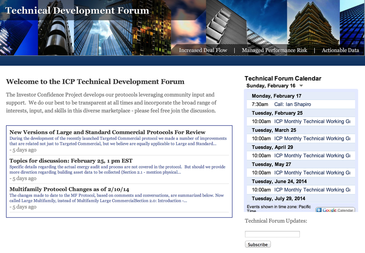
The Investor Confidence Project is proud to announce the launch of our new Technical Forum. This section of our website is intended as a portal between our development team, the technical oversight committees, and the general public. Our goal is to provide even greater transparency into our development efforts, and a means for contributors to comment or provide input into the many issues these protocols and specifications work to address. 

We will be keeping this new area of the ICP website up to date with the most recent working drafts for protocols in development, and with links to past forum calls, and notes.

The site features recent news and a calendar showcasing upcoming technical discussions, webinars, and other events. The Technical Team Blog contains information about current topics under discussion, recent changes to the protocols, and other updates. Recordings of all of the Technical Forum discussions are also archived and available.

We will be keeping the Technical Forum up to date with all protocols and technical efforts under development.

Currently, the site features a section dedicated to the effort involved with the development of the Multifamily Protocol, including a link to the most recent draft of the protocol, a list of technical resources used in its development, and a team directory.  

There is also a section of the site dedicated to the development of the Quality Assurance Specifications, and links to the QA Checklists developed for the Large and Standard Commercial Protocols.

We have also posted a discussion draft for upcoming ICP Designations for projects that meet the ICP requirements, and key actors in the system including Software Providers, Project Developers, and Quality Assurance Providers.  

We invite you to contribute to these development efforts, provide your input and insight, and get involved by becoming an ICP ally, joining one of our technical working groups, and helping the ICP reach critical mass.  We are excited that this new area on the website will improve our ability to communicate to our stakeholders and encourage even more engagement and transparency.

Please sign up to receive periodic technical updates using the form below:
Follow The ICP Technical Forum:


Visit the ICP Technical Forum:
Technical Forum
Comments

ICP and PACEnow Webinar and Panel - Recording Now Available

2/7/2014

Comments

 
“What do I think about 2014?  I think it’s going to be a breakout year for PACE...”
                                                                       
                                                                                       - David Gabrielson, Executive Director of PACEnow
Picture
The Investor Confidence Project, in partnership with PACEnow, recently presented a well attended webinar on the topic of how standardization can increase confidence in savings projections, reduce transaction costs, and ultimately increase investment and demand for energy efficiency in conjunction with Commercial Property Assessed Clean Energy (PACE) programs.

On this webinar we were privileged to have an all-star panel consisting of some of the leading PACE experts from across the country.  Introductions and overviews were given by Matt Golden, Senior Energy Finance Consultant at EDF and ICP Lead, and by David Gabrielson, Executive Director at PACEnow.  This was followed by a lively panel discussion fielding questions from our audience.  The panel included Brian McCarter, CEO at Sustainable Real Estate Solutions, Charlene Heydinger, Executive Director at Keeping PACE in Texas, and John Kinney, CEO at Clean Fund. 

You can download a PDF of the presentation from this webinar or view the webinar below:

PictureClick to Enlarge
Below are some of the highlights from the panel discussion:

PACE Programs are Growing - David Gabrielson, PACEnow:
In 2010 there were only 2 states containing a few PACE funded projects, California and Colorado.  Today, there are 7 states with PACE funded projects and 26 Commercial PACE  platforms operating throughout the country (see PACEnow Infographic).  Furthermore, 208 projects have been completed totaling over $63 million.

Success in Connecticut - Brian McCarter, Sustainable Real Estate Solutions:
Under the direction of the Clean Energy Finance and Investment Authority (CEFIA) Connecticut Commercial PACE programs have been growing since their implementation a year ago.  For example, 200 contractors have been trained on integrating Commercial PACE into the project development process and 200 applications have been received worth around $75 million in proposed project value.  Stay tuned, because later in February CEFIA plans to announce a PACE industry event with the sale of the first portfolio of CPACE projects to a third party capital provider, valued at $7.5 million.

Protecting the Consumer - Charlene Heydinger, Keeping PACE in Texas:
Texas has 1,200 municipalities and 245 counties, and each one will determine if they want a PACE program.  Uniformity is at the forefront for Keeping PACE in Texas, simply because of the state’s size.  By commencing Commercial PACE in a homogenous way, it allows for more stable metrics and the hope that transaction costs can be limited and more user friendly.

The Triple Bottom Line - John Kinney, Clean Fund:
PACE programs can’t work without aligning interested parties.  Vendors and real estate owners need to have the resources to interact with each other and to understand the metrics involved. Additionally, PACE programs imply a public / private partnership between the government and a range of private sector stakeholders including finance companies, ESCOs, building owners, utilities, and many others - making it even more important for these projects to have a triple bottom line impact.


We appreciate the active participation of our audience who asked some very insightful questions, as well as the expert opinions from our esteemed panel.  If you are interested in discussing further how ICP can be applied to Commercial PACE or any of the many use cases discussed during this webinar, please contact ICP to discuss.
Comments

Interest in the Investor Confidence Project Grows in Europe

2/6/2014

Comments

 
Picture
As interest in and adoption of EDF’s Investor Confidence Project (ICP) protocols has continued to grow in the United States, so too has interest internationally. The Investor Confidence Project was invited to showcase our efforts at ESCO Europe, the continent’s largest conference for energy service providers. This year, the conference was held in Barcelona, Spain and drew an array of participants from across Europe and the public and private sectors, including representatives from finance companies, governments, and non-profits with interests in the energy industry.

I was privileged to serve as both a panelist in a roundtable discussion on barriers to ESCO financing, and a speaker on “Improving Access to Finance,” a well-attended session with representatives from the European Investment Bank, European Bank for Reconstruction and Development, and European Energy Efficiency Fund.

EDF was invited to attend this conference based on a series of conversations over the last year with European stakeholders facing the same barriers to investing in energy efficiency as their American counterparts. With policymakers in Europe similarly counting on a vast expansion of the market in building retrofits and an expected influx of private and public capital, there is a focus on standardization and policies that can enable capital and investors to enter the market with fewer transaction costs.

Picture
Over the course of the three-day ESCO Europe event, the ICP team met with more than thirty stakeholders. The feedback on ICP was extremely positive, with stakeholders sharing the view that the ICP protocols meet European goals of spurring more energy efficiency projects and reducing carbon emissions while being adaptable to the European market. After becoming familiar with the Investor Confidence Project and its objectives, European stakeholders agreed that working together to create a version of the ICP protocols in Europe would help standardize the market on a global level.

As a result, the Investor Confidence Project is now in conversation with a range of public and private stakeholders from across the European Union and U.K. about ways to link and collaborate on our efforts. In particular, we have been working with Steven Fawkes from the U.K., an author on ESCO financing who also has a long history in the energy efficiency field and private sector experience in the ESCO industry.

There is a great opportunity to expand the scope of ICP to develop a parallel set of protocols for the European marketplace. As a first step in the process, we will gather a broad steering committee with both geographic and stakeholder diversity to develop a plan for both funding and execution. Working to adapt our current protocols offers a major advantage for the Europeans, both in terms of time and effort, as we won’t be starting from scratch. There’s also the added benefit of creating a more consistent market across the U.S. and Europe, which will speed adoption in both markets.

One of our key takeaways from the ESCO conference is that while here in the U.S. we tend to look to Europe as more advanced, Europe is actually looking to the U.S. for solutions. In reality, we are all struggling with the same basic set of market barriers, and there appears to be substantial opportunity for collaboration on many fronts.

We look forward to ongoing collaboration with our European counterparts and believe that in an age of global markets, linking efforts to overcome similar barriers to scaling energy efficiency investment will help accelerate both markets.

Please contact us if you are interested in participating in the ICP Europe effort.

Comments

    RSS Feed

    Archives

    April 2025
    November 2024
    May 2024
    July 2023
    July 2021
    June 2019
    March 2019
    March 2018
    January 2018
    December 2017
    October 2017
    August 2017
    January 2017
    December 2016
    October 2016
    August 2016
    July 2016
    June 2016
    April 2016
    March 2016
    February 2016
    January 2016
    December 2015
    November 2015
    October 2015
    September 2015
    August 2015
    July 2015
    June 2015
    April 2015
    March 2015
    February 2015
    December 2014
    November 2014
    October 2014
    September 2014
    July 2014
    June 2014
    May 2014
    April 2014
    March 2014
    February 2014
    January 2014
    December 2013
    November 2013
    October 2013
    September 2013
    August 2013
    July 2013
    June 2013
    May 2013
    March 2013
    January 2013
    December 2012
    October 2012

    Categories

    All
    179d
    25e
    Ab758
    Benchmarking
    California Energy Commission
    Carbon Credit
    Cec
    Credentialing
    Edf
    Eepp
    Energy Software
    Femp
    Icp
    Insurance
    Leasing
    Low Income Weatherization
    Measurement And Verification
    M&V
    Pace
    Performance
    Ppa
    Risk Management
    Software
    Software Providers
    Solar
    Tax Credits
    Ump
    Uniform Methods Project
    Wap

Contact the Project