ICP
  • About
    • ICP for Programs, Financiers, and Green Banks >
      • GHG Accounting
      • Adaptive Reuse
      • Certification Timing
      • Post-Cert Changes
    • How Does ICP Work? >
      • Project Framework
      • Roadmap to IREE Certification
    • GGRF EPA Reporter
    • Tech Forum >
      • Technical Forum Blog
      • Discussion Notes
      • Call Recordings
      • Reference Documents
      • Glossary
      • Acronyms
      • Protocol Archives
    • ICP in Canada
    • Contact Us
  • Training
  • IREE Certification
    • Guide to IREE Certification
    • Commercial Protocols >
      • Large Commercial
      • Standard Commercial
      • Targeted Commercial
      • Basic / Performance
    • Multifamily Protocols >
      • Large Multifamily
      • Standard Multifamily
      • Targeted Multifamily
      • Basic / Performance
    • Project Development Specification
    • Project Registration >
      • Performance Update
    • Tools and Templates >
      • Cx, O&M, M&V Templates
      • QA Checklists
      • Building Button
    • Case Studies
  • Providers
    • Project Developer Network >
      • Join the ICP PD Network
    • Quality Assurance Assessors >
      • Join ICP's Quality Assurance Asserssors
  • Blog
    • Blog
    • ICP In the News

Large Commercial Protocol

ICP Protocol - ​​Large Commercial

Download ICP-LC Protocol
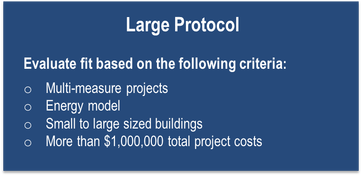
The ICP Protocol for Large Commercial is designed for commercial energy efficiency projects consisting of multiple measures costing typically over $1M where project complexity and costs necessitate rigorous engineering requirements.  These projects are typically considered "high performing projects" where the cost of improvements and magnitude of savings at risk justifies greater time and effort in pre-and post-project development energy analysis utilizing pre- and post-retrofit meter data gathering approaches.  

This protocol prescribes a whole building energy modeling approach as well as metered pre- and post-retrofit data-driven (IPMVP Option C-type) approach to measurement and verification. However, such an approach may not be appropriate for buildings that do not have relatively stable fundamental energy use patterns (such as those characterized by large and frequent changes in the type of space use or inconsistent schedules). In such cases, alternative methods such as IPMVP Options A or B, covered under the Standard Commercial ICP Protocol, may be required.

​
One of the first steps in your ICP project journey is to select the most appropriate protocol. Retrofit projects are not simple to classify, so Project Developers should work with their Quality Assurance Providers and Investors to select the protocol that is the best fit for each project based on that projects size, scope, and risk profile. The goal is to achieve "substantial" compliance with all requirements of the selected protocol, however, working with a professional engineer as a selected third party quality assurance provider, protocols can be adapted to fit each project so long as any changes are documented in notes to the QAA check-list, and do not substantially affect the accuracy and rigor of the certification.​
​
Picture
Picture

Contact the Project