ICP
  • About
    • ICP for Programs, Financiers, and Green Banks >
      • GHG Accounting
      • Adaptive Reuse
      • Certification Timing
      • Post-Cert Changes
    • How Does ICP Work? >
      • Project Framework
      • Roadmap to IREE Certification
    • GGRF EPA Reporter
    • Tech Forum >
      • Technical Forum Blog
      • Discussion Notes
      • Call Recordings
      • Reference Documents
      • Glossary
      • Acronyms
      • Protocol Archives
    • ICP in Canada
    • Contact Us
  • Training
  • IREE Certification
    • Guide to IREE Certification
    • Commercial Protocols >
      • Large Commercial
      • Standard Commercial
      • Targeted Commercial
      • Basic / Performance
    • Multifamily Protocols >
      • Large Multifamily
      • Standard Multifamily
      • Targeted Multifamily
      • Basic / Performance
    • Project Development Specification
    • Project Registration >
      • Performance Update
    • Tools and Templates >
      • Cx, O&M, M&V Templates
      • QA Checklists
      • Building Button
    • Case Studies
  • Providers
    • Project Developer Network >
      • Join the ICP PD Network
    • Quality Assurance Assessors >
      • Join ICP's Quality Assurance Asserssors
  • Blog
    • Blog
    • ICP In the News

ICP and Allies Support Access to Whole Building Energy Data

4/29/2014

Comments

 
Picture
The Investor Confidence Project (ICP) and twenty of our project allies were pleased to provide comment to the California Public Utilities Commission (CPUC) on the Proposed Decision in Rulemaking 08-12-009.  ICP and our allies are asking Commission to allow utilities to provide building owners and managers with access to whole-building monthly energy usage data for benchmarking and Energy Efficiency Baselining and M&V upon request.

The industry of energy efficiency retrofitting requires data to drive investment and innovation leading to reductions in energy loads and associated greenhouse gasses.  Multi-tenant buildings present a particular challenge, as it is often difficult to get necessary data for benchmarking, base lining, and ongoing measurement and verification.  The existing process of obtaining separate consent for each meter is too impractical to be employed which has a significant impact.  Changing the requirements to allow building owners to obtain aggregate data would spur a number of beneficial developments. 

Access to whole-building data enables project developers and building owners to effectively engineer energy efficiency projects and measure results.  In order to develop projects and justify investments, it is imperative that building energy usage can easily be obtained both pre and post project.  The current inability to do so creates a significant barrier to creating more and deeper retrofits. 

Easier data access would also allow for participation in benchmarking programs allowing California businesses to focus our energies on using benchmark data to manage energy effectively, rather than dedicate resources to cutting red tape. Similarly, many REITs and other large players are currently hampered in tracking and reducing energy use to meet requirements associated with programs such as the Global Real Estate Sustainability Benchmark (GRESB), ULI-GreenPrint Index, or LEED Certification.

Lastly, data is necessary to improve the energy performance of buildings implementing operational and behavioral energy-saving strategies.  In order for building engineers to improve existing infrastructure, as well as properly commission newly installed equipment upgrades, it is necessary to make building energy data accessible. 

The Investor Confidence Project’s partners and allies has asked the CPUC to direct the CA investor owned utilities to provide building owners and managers with access to whole-building monthly energy usage data for benchmarking upon request.

The following ICP Allied companies and organizations have formally endorsed this letter:
  • Los Angeles Better Buildings Challenge
  • Celtic Energy
  • Clean Fund
  • Metrus Energy
  • Carbon Lighthouse
  • PACENow
  • Association for Energy Affordability
  • Retroficiency
  • Performance Systems Development
  • Sustento Group
  • Joule Assets
  • Sidel Systems
  • Building Energy
  • SCIenergy
  • HELiOS Building Efficiency
  • New York Energy Efficiency Corporation
  • MJM Energy Consulting
  • Sustainable Real Estate Solutions
  • Noesis
  • Brightpower

EDF and ICP comment letter on cpuc proposed decision in rulemaking 08-12-009
File Size: 294 kb
File Type: pdf
Download File

Comments

NEW RELEASE: Multifamily Energy Performance Protocols

4/24/2014

Comments

 
Picture

The Investor Confidence Project (ICP) is pleased to announce the release of a new series of Multifamily Energy Performance Protocols (EPP) that build on ICP’s successful commercial protocols to bring the benefits of standardization to a broader array of project types.  This suite of three protocols include Large Multifamily for whole building projects over $1M, Standard Multifamily for smaller whole building projects typically less than $1M, and Targeted Multifamily for single measures.

The multifamily protocols were developed with the collaboration of industry experts including participating members of the ICP Multifamily Development Team and the ICP Ally Network.  The bulk of the protocols are comprised of the same market tested methodologies that can be found in all of ICP’s Energy Performance Protocols.  However, the multifamily versions have been designed to address considerations that apply to the multifamily sector including the issues of split incentives and tenant privacy.   

As with all of  ICP’s Energy Performance Protocols, the goal is to standardize how projects are baselined, engineered, installed, operated and measured.  This allows investors and building owners to gain confidence in the long-term return on their energy efficiency investments as well as reduce the transaction costs associated with developing projects.  The protocols form the backbone of the ICP workflow that streamlines the development process and results in ICP Investment Ready Projects by leveraging ICP’s network of designated project developers, software providers, and quality assurance engineers.  Investors of all types, especially building owners, can be confident that ICP Investor Ready Energy Efficiency projects have been developed using industry best practices to provide reliable returns and reduced performance risk.  

The Investor Confidence Project thanks all of its contributors and supporters, especially the Multifamily Technical Forum,  that make continued development of our protocols possible.  We welcome any additional feedback that the industry can provide via the Technical Development Forums of our website.  Lastly, the Investor Confidence Project seeks your help in achieving critical mass and encourages organizations who support industry standardization to sign up for membership in our no-cost Ally Network.

Comments

European Union EE Financing Report Highlights Need for ICP

4/22/2014

Comments

 
Picture
The European Union’s Energy Efficiency Financials Institutions Group, jointly convened by the European Commission and the United Nations Environment Programme Finance Initiative (“UNEP FI”) recently released a report “Energy Efficiency – the first fuel for the EU Economy, How to drive new finance for energy efficiency investments.”

The report highlights the importance of energy efficiency and describes the resource as “EU’s biggest energy resource and one of the most cost effective ways to enhance the security of its energy supply and decrease the emissions of greenhouse gases and other pollutants. This is why the EU has a 20% primary energy consumption saving target for 2020 and further legislation in the field.”

PictureDownload Report
It is clear that there are many similar efforts in the European Union and the United States, aimed at address a set of barriers to investment in energy efficiency that transcend borders and oceans. Issues such as climate change, increasing energy costs, and the large amount of energy imports the EU requires, means that energy efficiency is front and center on the European Union's agenda.  

The report focuses on a series of key areas of focus that include accounting for the full benefit of retrofits, increase enforcement of codes and standards, access to data, and investment standardization.  The report also supports increases public-private investment partnerships.

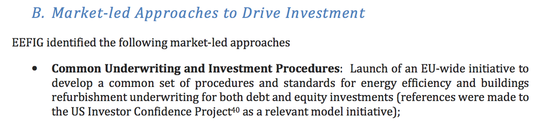
Of particular relevance to the Investor Confidence Project efforts, the report highlights ICP as an example of approaches to standardization underwriting and investment procedures for energy efficiency investments.

Picture
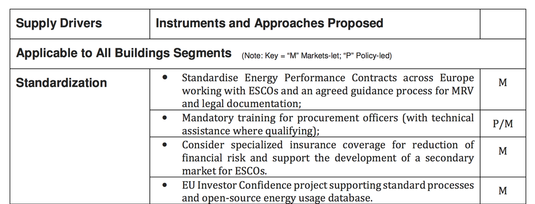
Later in the report, our growing efforts around ICP Europe applies to at least three areas that are identified as "building blocks to develop a practical framework to stimulate energy efficiency investment in buildings."  One of those critical areas is listed has to do with Standardization (below),  however ICP EU was also highlighted as helping to establish a "Clear Business Case, Leadership and Awareness at Key Decision Maker Level" and to help provide a "Strong, Stable and Well-enforced Regulatory Framework." 
Picture
ICP has been gaining traction in Europe in this year including the establishment of a broad based European steering committee including both policymakers, investors, and industry.

Matt Golden, Senior Energy Finance Consultant, attended ESCO  Europe, the continent’s largest conference for energy service providers, specifically to talk about how ICP is being used in the U.S. and how adaptable it can be for the European market. Since the conference and along with the release of this report, ICP has been engaging in conversations with European stakeholders to further advance a plan to raise funds and execute a European ICP initiative.

We look forward to additional European engagement in ICP and believe that in a global economy, the more we can align our efforts the more investment and energy efficiency we will achieve.

2014_fig_how_drive_finance_for_economy.pdf
File Size: 1594 kb
File Type: pdf
Download File

Comments

ICP Protocols Standardize EE Projects as part of Texas PACE-in-a-Box 

4/15/2014

Comments

 
Picture
Texas currently has the highest rate of energy consumption of any U.S. state and accounts for 10% of the country’s total energy consumption. Most of that energy goes to energy-intensive industries, such as aluminum, chemicals, forest products, glass, and petroleum refining, which consume 50% of the state’s energy, compared with a national average of 32%.

Last year, the Texas legislature passed statewide legislation enabling cities to use their property assessments as a way to finance clean energy and energy efficiency for industrial, agriculture, water, and commercial buildings. This innovative financing tool, generally referred to as property-assessed clean energy (PACE), has the potential to unlock a considerable amount of funding for both renewable energy and energy efficiency projects in the state, while simultaneously offering building owners cheaper financing options and secure repayment through their property assessment.

While PACE holds great promise in Texas with its over 1,200 incorporated cities, stakeholders have expressed concern that each of these cities could develop its own program with unique requirements, leading to confusion and creating bottlenecks for a successful roll-out. A consistent approach to PACE implementation and program rules would, however, vastly increase the chances of success.

In order to get ahead of this potential issue and create the consistency desired by all, Keeping PACE in Texas, a non-profit devoted to bringing PACE programs to Texas, has been working with a wide array of stakeholders to develop a do-it-yourself toolkit, called “Pace in a Box.” This toolkit provides local Texas officials with a set of necessary steps, program rules, and technical requirements. Pace in a Box, released today, will facilitate a consistent statewide approach to implementing PACE financing as well as allow local Texas governments to establish effective PACE programs quickly and economically.

Pace in a Box will include energy efficiency protocols developed by EDF’s Investor Confidence Project (ICP) as its recommended standard for developing projects, estimating energy and financial savings, and documenting and verifying results. By establishing a standardized process, the ICP Protocols will allow investors, building owners, and energy service companies to deploy PACE at scale in Texas. Input from stakeholders has shown that consistency and standardization are critical to growing the market and attracting investors.

Embedding ICP’s standards into the PACE in a Box toolkit not only creates consistency across the state of Texas, but also aligns the state with a growing number of national programs and investors. Ultimately, this could create an energy efficiency market on a national level.

Keeping PACE in Texas also avoided the costly and time-consuming process of developing proprietary program standards by using the ICP framework in its toolkit. Keeping PACE in Texas released the first version of its PACE in a Box toolkit this week to solicit feedback from stakeholders before launching a finalized version, scheduled for May 30, 2014.

The incorporation of ICP’s standards into the Pace in a Box toolkit reflects ICP’s growing momentum across the country as well as its rapidly-expanding Ally Network, which includes over 70 partners from both private industry and investors as well as an ever-expanding set of public programs.

Comments

Updated Large and Standard Commercial Protocols Released

4/15/2014

Comments

 
Picture
The Investor Confidence Project (ICP) is pleased to announce the release of updated versions of its protocols, specifically the Energy Performance Protocol for Large Commercial v1.2 and Energy Performance Protocol for Standard Commercial v1.1.  

These new releases incorporate additional feedback from the marketplace obtained through the participation of various industry stakeholder members of the ICP Technical Forum and Ally Network.  The newest versions of the protocols reflect ICP’s goal of continually strengthening the protocols based on input from industry experts in the field.
   
These updated versions' improvements include :
  • Clarification to specific baseline, including baseline operational and performance data requirements
  • Addition of a retrofit-isolation baseline to the Standard Commercial protocol
  • Clarification to specific savings calculation, including investment criteria, the use of inflation values, and equipment useful life expectancy
  • Replacement of the Design, Construction and Commissioning section with an operational performance verification approach
  • Addition of training requirements to the Operations, Maintenance and Monitoring section, as well as the requirement of a plan for remediation of issues
  • Requirement of a measurement and verification plan

The latest versions are integrated into a newly redesigned website format that fosters collaboration between our development team, the technical oversight committees, and the industry in order to provide greater transparency and the ability to rapidly respond to participants’ feedback.  The site features a number of collaboration tools including moderated discussion areas, the Technical Team Blog,  recordings of all of the Technical Forum discussions, and Technical Forum development calendars.  

The ICP Team continues to rollout a complete suite of offerings.  Upcoming deliverables on our development schedule are the first Multifamily Energy Performance Protocol, a Quality Assurance Specification, and introduction of ICP Designations.

The Investor Confidence Project thanks all of its contributors and supporters that make continued development of our protocols possible.  We welcome any additional feedback that the industry can provide via the Technical Development Forums of our website.  Lastly, the Investor Confidence Project seeks your help in achieving critical mass and encourages organizations who support industry standardization to sign up for membership in our no-cost Ally Network.

Comments

ICP Featured at Innovations in EE and Distributed Generation Finance

4/9/2014

Comments

 
Picture
EDF's Investor Confidence Project (ICP) Team attended the Innovations in Energy Efficiency and Distributed Generation Finance III on March 27th.  The conference was hosted by Citi, Elevate Energy, Wilson Sonsini Goodrich & Rosati, and the Environmental Defense Fund.  The conference was well attended by energy efficiency leaders representing the full spectrum of industry stakeholders.

The conference featured panel discussions with some of the most innovative individuals in the industry including John Kinney (Clean Fund), Scott Harmon (Noesis), Jessica Bailey (CEFIA), Bob Hinkle (Metrus), Steve Gossett Jr. (SCI Energy), and Jody Clark (Hannon Armstrong) to name just a few.  ICP  was honored to be mentioned during numerous discussions and is seeing an unprecedented level of support and adoption.  A number of attendees commented on the progress ICP has made since the conference two years ago where the nascent project was still under early development.  Based on the number of references to ICP’s Energy Performance Protocols by various speakers, it is obvious that the market continues to realize the value of protocol based standardization as ICP sees continued adoption.

A special presentation dedicated to ICP was led by EDF’s Senior Energy Finance Consultant, Matt Golden (pictured).  The presentation featured the public debut of ICP’s Provider Designation System which was well received by the audience, many of whom have indicated interest in receiving the new designations.

The ICP Team took the opportunity to convene with attending members of its Ally Network and provided value add by connecting its members to each other.  ICP looks forward to attending the ACEEE Energy Efficiency Finance Forum May 11 - 13 where we hope to continue building relationships with our Allies and other industry leaders.  Individuals who are attending the conference and would like to meet with ICP to explore business opportunities are encouraged to contact us in order to schedule a meeting during the event.

Comments

LA Better Building Challenge Partners with ICP to Increase Demand

4/2/2014

Comments

 
Picture
Environmental Defense Fund’s Investor Confidence ProjectSM (ICP) is pleased to announce a partnership with the Los Angeles Better Buildings Challenge to help develop a more robust marketplace for energy efficiency retrofits in the city. Los Angeles has set a goal of achieving 20% energy savings across 30 million square feet_ of existing buildings by 2020 as part of the Better Buildings Challenge, a national leadership initiative sponsored by the U.S. Department of Energy. If achieved, it is estimated that this 20% reduction in energy costs will create over 7,000 high-quality local jobs, and avert annual carbon emissions equivalent to taking more than 18,000 cars off the road.

The LA Better Buildings Challenge will be promoting the ICP Protocols through its network of building owners and industry stakeholders to help bring even greater transparency and accountability to the energy efficiency market by introducing a system of standardization in the way commercial building retrofits are developed, funded, and managed. The ICP framework assembles best practices and existing technical standards into a set of protocols that define a clear roadmap for developing projects, determining savings estimates, and documenting and verifying results.

Picture
David Hodgins, Executive Director of the LA Better Buildings Challenge, describes how the partnership with ICP will help the project meet its goal. “The mission of the LA Better Buildings Challenge is to support our partners in achieving a minimum of 20% savings by 2020, and to get there we need to have a clear path. We are excited to partner with ICP, which offers our partners a best-practice approach to developing, underwriting, and measuring the impact of their resource efficiency projects,” he said.

With the goal of driving at least $25 million in total investment, the LA Better Buildings Challenge has developed a directory of capital providers to facilitate access to project funding options. Using the ICP protocols, EDF will work with the LA Better Buildings Challenge to increase deal flow and expand its pool of investors putting dollars to work in Los Angeles’ economy.

The ICP Protocols are designed to increase confidence in energy and financial savings among building owners, project developers, and investors, making it easier to overcome the many barriers that make it hard for projects to move from a good idea to construction. The ICP team is working with LA Better Buildings Challenge to connect local companies, building owners, and projects to local investors and our national network of Project Allies. This service will provide them with a range of relevant options, from energy service agreements and debt and equity financing, to insurance products and a diversity of software tools.

Adopting the ICP framework will save LA Better Building Challenge partners from the expensive and time-consuming process of creating and maintaining unique technical project requirements that would otherwise result in a patchwork of program requirements across California and the county, increasing transaction costs for project developers, building owners, and investors alike.

The LA Better Buildings Challenge has been extremely active in engaging the public and private sectors, as well as building owners in order to meet the target goal. Achieving a reduction of 20% in energy savings will significantly reduce operating costs for building owners (freeing up capital for more productive uses), enhance tenant comfort and productivity, and boost market competitiveness.

The LA Better Building Challenge is a great example of how the Investor Confidence Project can support the ongoing growth of an established energy efficiency program and enable deeper investments in energy efficiency. We look forward to working closely with the LA Better Buildings Challenge and a range of other program partners as we help establish a consistent national marketplace for energy efficiency investment. 

Comments

    RSS Feed

    Archives

    April 2025
    November 2024
    May 2024
    July 2023
    July 2021
    June 2019
    March 2019
    March 2018
    January 2018
    December 2017
    October 2017
    August 2017
    January 2017
    December 2016
    October 2016
    August 2016
    July 2016
    June 2016
    April 2016
    March 2016
    February 2016
    January 2016
    December 2015
    November 2015
    October 2015
    September 2015
    August 2015
    July 2015
    June 2015
    April 2015
    March 2015
    February 2015
    December 2014
    November 2014
    October 2014
    September 2014
    July 2014
    June 2014
    May 2014
    April 2014
    March 2014
    February 2014
    January 2014
    December 2013
    November 2013
    October 2013
    September 2013
    August 2013
    July 2013
    June 2013
    May 2013
    March 2013
    January 2013
    December 2012
    October 2012

    Categories

    All
    179d
    25e
    Ab758
    Benchmarking
    California Energy Commission
    Carbon Credit
    Cec
    Credentialing
    Edf
    Eepp
    Energy Software
    Femp
    Icp
    Insurance
    Leasing
    Low Income Weatherization
    Measurement And Verification
    M&V
    Pace
    Performance
    Ppa
    Risk Management
    Software
    Software Providers
    Solar
    Tax Credits
    Ump
    Uniform Methods Project
    Wap

Contact the Project