
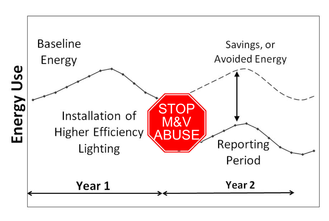
The Investor Confidence Project’s (ICP) Large Commercial and Large Multifamily protocols both specify the International Performance Measurement and Verification Protocol’s (IPMVP) Option C, Whole Facility approach. This approach makes sense for larger projects involving multiple measures, usually with interactivity, in which the predicted energy savings are greater than 10% of the building’s total energy use. It also makes sense from the fundamental perspective that building owners and financiers can use utility bills to determine if energy savings have been realized.
But comparing utility bills “as-is” would be a mistake – because if nothing else, no one can predict the weather. Ask any weather forecaster or farmer. This is where “adjustments” come into play.
The general equation listed in the IPMVP Volume I, 2012 (Section 4.1) takes this form:
Savings = (Baseline Period Use - Reporting Period Use) +/- Adjustments
The “adjustments” term is commonly used to restate the baseline energy use in terms of the reporting period conditions. Routine adjustments (most commonly weather) that are expected to change routinely can be accounted for (through regressions or other techniques) to adjust both the baseline and reporting periods for the same set of conditions. This allows for accurate comparison between the two periods, providing an “apples to apples” comparison.
And then there are the “non-routine adjustments” – routine adjustment’s misunderstood and often abused little brother. Non-routine adjustments are factors that were not expected to change, such as facility size, operation of installed equipment, conditioning of previously unconditioned spaces, number of occupants, or load changes to name a few.
This is where Option C can get messy and become more art than science. The fact is that the application and effect of these adjustments can be confusing or challenging to apply and account for properly. Non-routine adjustments place strong dependence on the engineering prowess of the measurement and verification (M&V) agent to estimate the impacts of the adjustments. In many cases, the M&V agent is also the project implementer (who may have a vested interest in the M&V outcome), which creates an obvious potential for a conflict of interests.
The first step is to identify these changes in the reporting period. This can be accomplished through interviews with the building owner and facility personnel, periodic site visits, observation of unexpected energy usage patterns, or other methods. It is important to bear in mind that not all changes in the building need to be (or can reasonably be) accounted for in the M&V effort. Identifying changes that warrant adjustment is a critical part of the process. For instance, Gladys’ new personal desk fan probably does not warrant an adjustment. An increase in the number of occupants over a four-month period, on the other hand, would have enough impact to warrant adjustment.
The second step is to establish a method for accurately calculating how the identified changes will affect the facility’s energy use. Sometimes these effects can be estimated within the energy modeling software that was used to calculate the energy savings for the project. In other cases, side calculation methods must be employed. Applying the appropriate level of rigor and sound engineering principles is key, but is not always accomplished.
Which assumptions should be utilized in these non-routine adjustment calculations? As with the original savings calculations, no matter how thorough and sound the calculation methodology may be, the assumptions will impact the calculated values. There are many factors that must be taken into account. What kind of activity levels are exhibited by the new occupants? What are the new equipment schedules? How often are schedules being overridden? How much heat does the new CT scanner give off How often does it run? How many of the photometric light-level sensors been covered over with tape? The list of considerations can be extensive.
Non-routine adjustments can make or break a project. Utility bills that show an increase in post-retrofit overall energy use can suddenly show energy savings (and in some cases this may be justifiable). Non-routine adjustments can play a major role in demonstrating achieved energy savings, but they also can be misapplied or misused, leading to inaccurate results. They present an opportunity for abuse, an opening for poor judgement, or an excuse for a lack of resources. All of this is further complicated by the fact that many people misunderstand the energy modeling or calculation methods being used to calculate these adjustments.
So what can be done to prevent adjustment abuse? First, identify which changes to the building need to be accounted for and define the changes in enough detail so they are well understood by all parties. Second, identify and collect the necessary data to inform the assumptions used in these calculations and ensure that the data and assumptions are conservative. This involves making sure that appropriate resources have been agreed upon and accounted for early on in the project, as well as M&V efforts to allow development of the assumption values with proper attention. Finally, involve a third-party evaluator to perform the M&V phase – or at least to oversee and review the M&V process. Third-party review typically results in a less biased M&V result, as the calculation methods and assumptions that are employed may be challenged and subsequently vetted.
On its face, the Option C approach may seem like the most streamlined and straightforward approach to M&V. But the need for adjustments – particularly non-routine adjustments – can quickly complicate the process and degrade its value. This mantra, therefore, must be repeated for each M&V effort:
While the ICP and IPMVP provide methods and processes to reduce overall risk and increase energy efficiency project success, a level of quality assurance and oversight needs to be applied to these processes to ensure that “abuse” of the tools and assumptions used are minimized or eliminated. In the case of adjustments, only through strict adherence to these overarching principles can adjustment abuse be avoided, and project savings be verified in an open, reliable, and repeatable manner.
The Investor Confidence Project team has worked hard to increase confidence in measurement, and to the degree possible ensure that there are clear rules upfront as to how project savings are measured and adjusted.
But comparing utility bills “as-is” would be a mistake – because if nothing else, no one can predict the weather. Ask any weather forecaster or farmer. This is where “adjustments” come into play.
The general equation listed in the IPMVP Volume I, 2012 (Section 4.1) takes this form:
Savings = (Baseline Period Use - Reporting Period Use) +/- Adjustments
The “adjustments” term is commonly used to restate the baseline energy use in terms of the reporting period conditions. Routine adjustments (most commonly weather) that are expected to change routinely can be accounted for (through regressions or other techniques) to adjust both the baseline and reporting periods for the same set of conditions. This allows for accurate comparison between the two periods, providing an “apples to apples” comparison.
And then there are the “non-routine adjustments” – routine adjustment’s misunderstood and often abused little brother. Non-routine adjustments are factors that were not expected to change, such as facility size, operation of installed equipment, conditioning of previously unconditioned spaces, number of occupants, or load changes to name a few.
This is where Option C can get messy and become more art than science. The fact is that the application and effect of these adjustments can be confusing or challenging to apply and account for properly. Non-routine adjustments place strong dependence on the engineering prowess of the measurement and verification (M&V) agent to estimate the impacts of the adjustments. In many cases, the M&V agent is also the project implementer (who may have a vested interest in the M&V outcome), which creates an obvious potential for a conflict of interests.
The first step is to identify these changes in the reporting period. This can be accomplished through interviews with the building owner and facility personnel, periodic site visits, observation of unexpected energy usage patterns, or other methods. It is important to bear in mind that not all changes in the building need to be (or can reasonably be) accounted for in the M&V effort. Identifying changes that warrant adjustment is a critical part of the process. For instance, Gladys’ new personal desk fan probably does not warrant an adjustment. An increase in the number of occupants over a four-month period, on the other hand, would have enough impact to warrant adjustment.
The second step is to establish a method for accurately calculating how the identified changes will affect the facility’s energy use. Sometimes these effects can be estimated within the energy modeling software that was used to calculate the energy savings for the project. In other cases, side calculation methods must be employed. Applying the appropriate level of rigor and sound engineering principles is key, but is not always accomplished.
Which assumptions should be utilized in these non-routine adjustment calculations? As with the original savings calculations, no matter how thorough and sound the calculation methodology may be, the assumptions will impact the calculated values. There are many factors that must be taken into account. What kind of activity levels are exhibited by the new occupants? What are the new equipment schedules? How often are schedules being overridden? How much heat does the new CT scanner give off How often does it run? How many of the photometric light-level sensors been covered over with tape? The list of considerations can be extensive.
Non-routine adjustments can make or break a project. Utility bills that show an increase in post-retrofit overall energy use can suddenly show energy savings (and in some cases this may be justifiable). Non-routine adjustments can play a major role in demonstrating achieved energy savings, but they also can be misapplied or misused, leading to inaccurate results. They present an opportunity for abuse, an opening for poor judgement, or an excuse for a lack of resources. All of this is further complicated by the fact that many people misunderstand the energy modeling or calculation methods being used to calculate these adjustments.
So what can be done to prevent adjustment abuse? First, identify which changes to the building need to be accounted for and define the changes in enough detail so they are well understood by all parties. Second, identify and collect the necessary data to inform the assumptions used in these calculations and ensure that the data and assumptions are conservative. This involves making sure that appropriate resources have been agreed upon and accounted for early on in the project, as well as M&V efforts to allow development of the assumption values with proper attention. Finally, involve a third-party evaluator to perform the M&V phase – or at least to oversee and review the M&V process. Third-party review typically results in a less biased M&V result, as the calculation methods and assumptions that are employed may be challenged and subsequently vetted.
On its face, the Option C approach may seem like the most streamlined and straightforward approach to M&V. But the need for adjustments – particularly non-routine adjustments – can quickly complicate the process and degrade its value. This mantra, therefore, must be repeated for each M&V effort:
- Define the qualifying adjustments carefully, thoroughly and realistically.
- Develop conservative assumptions based on real data or industry-accepted values.
- Engage a third-party evaluator to provide oversight throughout the M&V process.
While the ICP and IPMVP provide methods and processes to reduce overall risk and increase energy efficiency project success, a level of quality assurance and oversight needs to be applied to these processes to ensure that “abuse” of the tools and assumptions used are minimized or eliminated. In the case of adjustments, only through strict adherence to these overarching principles can adjustment abuse be avoided, and project savings be verified in an open, reliable, and repeatable manner.
The Investor Confidence Project team has worked hard to increase confidence in measurement, and to the degree possible ensure that there are clear rules upfront as to how project savings are measured and adjusted.



 RSS Feed