
 Click to Enlarge
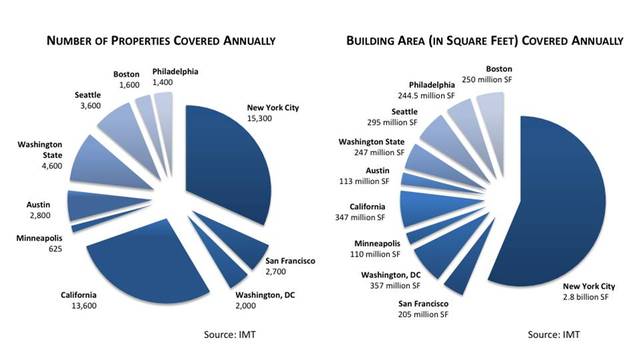
 With over four billion square feet already covered under building benchmarking ordnances in major cities across the country, chances are, if you are thinking about energy efficiency policy and program design, you are taking notice.
Building benchmarking refers to the rating of the relative energy efficiency of a building compared to its peers, and in many cases also includes making this information known to consumers. The mechanism aims to raise consumer awareness about energy performance and encourage building energy improvements through greater market transparency.
Benchmarking initiatives are growing in popularity and early results seem to support that there is a significant positive impact on demand for energy efficiency upgrades.
In 2012, an EPA analysis of 35,000 benchmarked buildings around the U.S. found that benchmarked buildings experienced, on average, 2.4% energy savings annually. Buildings that benchmarked for three years running saw an average energy savings of 7% during that same period. A 2012 report by the Georgia Tech Ivan Allen College School of Public Policy found that energy benchmarking in commercial properties could reduce national energy consumption by 5.6 percent in 2035. Another 2012 report, commissioned by the California Public Utilities Commission, found that benchmarking was highly correlated with building energy improvements and management actions, and was a strong catalyst for customer participation in utility clean energy rebate and incentive programs.
The Investor Confidence Project (ICP) supports benchmarking initiatives as critical to helping establish a linkage between energy performance and asset value, tenancy rates, rent levels and other key values of importance to building owners and tenants alike. Additionally, promoting transparency within energy performance puts pressure on building owners to ensure their buildings are competitive compared with their peers.
Generating demand for energy efficiency upgrades is the fundamental barrier in the market and benchmarking is a primary strategy to overcome this obstacle. However, there remains a critical need once a project has been developed to connect it with necessary investors in a form that enables underwriting and pooling of projects into understood asset classes.
The Investor Confidence Project’s Role in Building Energy Benchmarking
The ICP supports benchmarking programs by helping to create a roadmap from energy efficiency project development to the necessary array of investors and capital sources. The ICP Energy Performance Protocols (ICP Protocols) come into play once a building owner is ready to move forward with a specific energy efficiency project, providing a next step once a benchmarking program has helped establish demand.
Once a building owner has undergone a benchmarking and is ready to move forward with an actual upgrade to improve a building’s efficiency score as a way to improve cash-flow, the ICP establishes a pathway to develop a project in a form that enables a transparent market and reduces underwriting and engineering costs for investors. It is a common misunderstanding that there is not enough capital available. In reality, the true barrier is the lack of deal-flow. And the deals that do emerge are often apples and oranges, rather than apples to apples. Standardization will allow investors to more easily pool projects into large enough funds for senior capital investors, and will dramatically reduce costs associated with technical vetting and performance underwriting.
As the ICP Protocols begin to standardize benchmarking programs, they will help establish a single marketplace for commercial energy efficiency projects that will encourage investment and bring down the cost of capital. With more participation and standardization, this market will grow the bigger and become more attractive to clean energy investors.
We believe that there is great value for benchmarking programs to adopt the ICP Protocols as a standard approach to project requirements. This will help enable a nationwide market with sufficient scale to attract the array of investors and capital needed to realize energy efficiency’s full potential. This single market of similar projects makes attracting investors to energy efficiency substantially easier, and is a win-win for programs and building owners.
If you would like to learn how you can leverage the ICP protocols in your program, or for your projects, please become a project ally, and help us accelerate investment in energy efficiency.
Building benchmarking refers to the rating of the relative energy efficiency of a building compared to its peers, and in many cases also includes making this information known to consumers. The mechanism aims to raise consumer awareness about energy performance and encourage building energy improvements through greater market transparency.
Benchmarking initiatives are growing in popularity and early results seem to support that there is a significant positive impact on demand for energy efficiency upgrades.
In 2012, an EPA analysis of 35,000 benchmarked buildings around the U.S. found that benchmarked buildings experienced, on average, 2.4% energy savings annually. Buildings that benchmarked for three years running saw an average energy savings of 7% during that same period. A 2012 report by the Georgia Tech Ivan Allen College School of Public Policy found that energy benchmarking in commercial properties could reduce national energy consumption by 5.6 percent in 2035. Another 2012 report, commissioned by the California Public Utilities Commission, found that benchmarking was highly correlated with building energy improvements and management actions, and was a strong catalyst for customer participation in utility clean energy rebate and incentive programs.
The Investor Confidence Project (ICP) supports benchmarking initiatives as critical to helping establish a linkage between energy performance and asset value, tenancy rates, rent levels and other key values of importance to building owners and tenants alike. Additionally, promoting transparency within energy performance puts pressure on building owners to ensure their buildings are competitive compared with their peers.
Generating demand for energy efficiency upgrades is the fundamental barrier in the market and benchmarking is a primary strategy to overcome this obstacle. However, there remains a critical need once a project has been developed to connect it with necessary investors in a form that enables underwriting and pooling of projects into understood asset classes.
The Investor Confidence Project’s Role in Building Energy Benchmarking
The ICP supports benchmarking programs by helping to create a roadmap from energy efficiency project development to the necessary array of investors and capital sources. The ICP Energy Performance Protocols (ICP Protocols) come into play once a building owner is ready to move forward with a specific energy efficiency project, providing a next step once a benchmarking program has helped establish demand.
Once a building owner has undergone a benchmarking and is ready to move forward with an actual upgrade to improve a building’s efficiency score as a way to improve cash-flow, the ICP establishes a pathway to develop a project in a form that enables a transparent market and reduces underwriting and engineering costs for investors. It is a common misunderstanding that there is not enough capital available. In reality, the true barrier is the lack of deal-flow. And the deals that do emerge are often apples and oranges, rather than apples to apples. Standardization will allow investors to more easily pool projects into large enough funds for senior capital investors, and will dramatically reduce costs associated with technical vetting and performance underwriting.
As the ICP Protocols begin to standardize benchmarking programs, they will help establish a single marketplace for commercial energy efficiency projects that will encourage investment and bring down the cost of capital. With more participation and standardization, this market will grow the bigger and become more attractive to clean energy investors.
We believe that there is great value for benchmarking programs to adopt the ICP Protocols as a standard approach to project requirements. This will help enable a nationwide market with sufficient scale to attract the array of investors and capital needed to realize energy efficiency’s full potential. This single market of similar projects makes attracting investors to energy efficiency substantially easier, and is a win-win for programs and building owners.
If you would like to learn how you can leverage the ICP protocols in your program, or for your projects, please become a project ally, and help us accelerate investment in energy efficiency.


 RSS Feed