
ICP
  • About
    • ICP for Programs, Financiers, and Green Banks >
      • GHG Accounting
      • Adaptive Reuse
      • Certification Timing
      • Post-Cert Changes
    • How Does ICP Work? >
      • Project Framework
      • Roadmap to IREE Certification
    • GGRF EPA Reporter
    • Tech Forum >
      • Technical Forum Blog
      • Discussion Notes
      • Call Recordings
      • Reference Documents
      • Glossary
      • Acronyms
      • Protocol Archives
    • ICP in Canada
    • Contact Us
  • Training
  • IREE Certification
    • Guide to IREE Certification
    • Commercial Protocols >
      • Large Commercial
      • Standard Commercial
      • Targeted Commercial
      • Basic / Performance
    • Multifamily Protocols >
      • Large Multifamily
      • Standard Multifamily
      • Targeted Multifamily
      • Basic / Performance
    • Project Development Specification
    • Project Registration >
      • Performance Update
    • Tools and Templates >
      • Cx, O&M, M&V Templates
      • QA Checklists
      • Building Button
    • Case Studies
  • Providers
    • Project Developer Network >
      • Join the ICP PD Network
    • Quality Assurance Assessors >
      • Join ICP's Quality Assurance Asserssors
  • Blog
    • Blog
    • ICP In the News

Building Retrofits Just Got Easier Thanks to BOMA and ICP

8/28/2015

Comments

 
By: Karen Penafiel, Vice President, Advocacy, BOMA International

Picture
At its Every Building Conference this summer, the Building Owners and Managers Association (BOMA) International announced the relaunch of its BOMA Energy Performance (BEPC) toolkit.  BEPC is an industry-vetted, proven process to plan, procure, and implement performance-driven building retrofits that has been used in successful projects around the world. For this reason, BEPC and the Investor Confidence Project (ICP) are a “natural fit.”

Picture
ICP, an Environmental Defense Fund initiative designed to unlock investment in energy efficiency, is accelerating the development of a global energy efficiency market by standardizing how projects are developed and energy savings are calculated. Together, BEPC and ICP can be used to execute successful, reliable, investment-grade energy retrofit projects from concept through measurement and verification.

ICP’s Roadmap to Investor Confidence lays out six major steps in the project development cycle: origination, project development, quality assurance, certification, underwriting, contracting, and performance. BEPC includes a flexible framework and supporting toolkit of template documents that can assist building owners, operators, and program managers at each stage of this process. Two key areas where the BEPC toolkit is particularly useful in the ICP project development cycle are:

  1. Origination – Service provider selection
Any building owner or operator who has struggled with evaluating vendor pitches knows that selecting a service provider to design and execute a complex engineering project is a daunting challenge. Multi-measure building retrofit projects compound the difficulty, since there is no “apples to apples” comparison in a traditional competitive bid process and a simple low-bid requirement does not apply. For this kind of project, owners must find a true partner – not only one that can expertly handle the design and build portions of the project, but a partner that can also develop and execute the best project for the building and owner’s goals. This will ensure the project performs at or above expectations for the long term. The BEPC toolkit includes a step-by-step procurement and project development process, with templates for RFPs and other procurement documents to select a qualified energy service provider. These documents can easily incorporate ICP requirements around Project Developer Credentialing, Software Providers, standardized documentation to facilitate third party Quality Assurance, and Investor Ready Energy Efficiency Certification™.

  1. Project Development – Contracting for success
Developing a contract or agreement for a multi-measure building retrofit project can also be thorny.  Some service providers offer contracts, but these can be missing key protections for the owner, and can be very difficult for non-engineers (i.e., lawyers) to unravel. The BOMA Energy Performance Contract   toolkit includes a number of easy-to-use-or-adapt contracting documents that have been vetted by the real estate industry to reduce risk and protect owners’ interests. The BEPC documents incorporate many of the key features of ICP, including rigorous standards for developing a building’s energy-use baseline, transparent means of adjusting the baseline, and the ability to provide an energy savings guarantee, if desired (or required by investors). Again, BEPC aligns perfectly with the ICP mission to ensure that energy efficiency retrofit projects perform as expected.

ICP and BEPC in Practice
The LA Better Buildings Challenge (LABBC) provides a real-world example of how all of these pieces come together at the program level. Funded by the local utilities, LABBC works as a neutral third party to facilitate development of Investor Ready Energy Efficiency™ projects utilizing ICP and BEPC best practices.

As part of its onboarding process, the LABBC works with property owners to understand their investment criteria, internal capacity to manage and execute projects, existing contractor relationships, and areas of interest and opportunity .  Depending on the scope of the project, the owner’s internal resources, and contractor preferences, LABBC then recommends three firms from its list of prequalified Implementation Partners – each of whom has signed on to the BEPC Best Practices – and facilitates an expedited interview procurement process as described in the BEPC Toolkit. The selected Implementation Partner then conducts a comprehensive, investment-grade audit using an ICP-compliant software tool to facilitate quality assurance and certification by LABBC technical advisors and underwriting by the owner or third party funders. Once the scope of work is finalized, LABBC introduces the BEPC model contract language, including a full contract or contract exhibit to use with existing contract form agreements of the owner, to ensure that whatever agreement is used clearly addresses adjustments to the energy-use baseline, calculation of savings, transparent pricing, and measurement and verification.

ICP and the BEPC team are excited to continue finding ways to bring joint benefits of both programs to the retrofit industry. ICP is represented on the BEPC Advisory Board and the BEPC team and ICP plan to continue collaborating to increase the flow of rigorous, successful building retrofit projects.


Comments

ICP Seeks Support for New Jersey Pilot 

8/27/2015

Comments

 
Picture
The New Jersey Board of Public Utilities (BPU) Clean Energy Program has announced a proposed pilot program incorporating the Investor Confidence Project (ICP) system into their Pay for Performance (P4P) commercial and industrial energy efficiency whole building program. As proposed, the pilot program will introduce an alternative approach to accessing the BPU’s project incentives that will be based on Investor Ready Energy EfficiencyTM Certification of participating projects.  The proposed program will also include additional incentives for those programs that participate utilizing ICP. 

The Clean Energy Program has released the draft proposal which details the integration of ICP into the program. Comments and letters regarding the proposal are due by close of business September 1, 2015.  We hope for approval by the Board of Public Utilities at their meeting on October 15, 2015.

This pilot program is an exciting development for ICP. The N.J. Clean Energy Program has developed a voluntary, alternative compliance path for ICP that includes enhanced incentives for those projects that opt in and develop projects consistent with the ICP system. This pilot will provide New Jersey and the nation with important lessons learned about the value of ICP.

For stakeholders who have a national scope or have a presence in New Jersey it will be very helpful for the BPU to hear from you regarding your support for ICP. ICP has drafted a letter of support to the BPU that we hope you’ll sign on to (or better yet submit a letter on your own letterhead directly to the BPU at [email protected] by 9/1/15 with subject heading “Proposed P4P/ICP Pilot). 

To add your company’s name to the letter please send an email indicating your support as soon as possible to Mary Barber, EDF’s New Jersey Director, Clean Energy ([email protected]). who has been working closely with the NJ Clean Energy Program developing this pilot. 

Thank you for your support!
Picture
Comments

ICP Highlighted as Financing Strategy in NYSERDA's Clean Energy Fund Supplement

8/11/2015

Comments

 
Picture
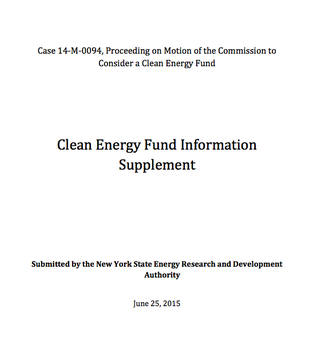
The Investor Confidence Project continues to work with a wide range of NY stakeholders.  We were pleased to see NYSERDA calling out ICP as a key financing strategy for 2016, based on the NY Public Service Commission direction to “refocus on market and technology transformative strategies.”

The Clean Energy Fund Information Supplement, which was submitted to the NY State Public Service Commission by the New York State Energy Research and Development Authority (NYSERDA) describes a range of New York State policies in support of Governor Andrew M. Cuomo’s Reforming the Energy Vision (REV) strategy.  


The content below is cut from the Clean Energy Fund Information Supplement and relates specifically to commercial financing and ICP: 


PictureClick to Download
Financing Standards, Tools, and Protocols
Starting in 2016, NYSERDA proposes to develop commercial financing strategies that will empower customers to invest in clean energy projects via market-rate, long-term self-sustaining financing solutions. These strategies will include efforts to support standards, such as the Environmental Defense Fund’s Investor Confidence Project (ICP) Energy Performance Protocols. These protocols are an amalgam of industry best practices, existing standards, and documentation that have been developed in order to create the data necessary to enable underwriting or managing of energy performance risk. Each of the protocols creates a standard set of documentation that will help standardize project performance underwriting leading to better data on performance, and a more efficient marketplace with less duplicative engineering and lower transaction costs. These benefits will ultimately result in an increase in deal flow and a more transparent and efficient market.

NYSERDA will promote existing financing options through the private market and other state entities, and will develop the tools and infrastructure required to expand the use of C-PACE financing. Specific activities for developing C-PACE include: Outreach to customers, key stakeholders and interest groups (including local governments to participate in offering C-PACE to their constituents); Periodic and targeted training sessions for contractors, installers, and other third party entities; and Facilitating the identification of a pipeline of qualifying projects, and providing bridge funding for verification services such as the ICP Energy Performance Protocols.

2015-nygb-clean-energy-fund-information-supplement.pdf
File Size: 2510 kb
File Type: pdf
Download File

Comments

    RSS Feed

    Archives

    April 2025
    November 2024
    May 2024
    July 2023
    July 2021
    June 2019
    March 2019
    March 2018
    January 2018
    December 2017
    October 2017
    August 2017
    January 2017
    December 2016
    October 2016
    August 2016
    July 2016
    June 2016
    April 2016
    March 2016
    February 2016
    January 2016
    December 2015
    November 2015
    October 2015
    September 2015
    August 2015
    July 2015
    June 2015
    April 2015
    March 2015
    February 2015
    December 2014
    November 2014
    October 2014
    September 2014
    July 2014
    June 2014
    May 2014
    April 2014
    March 2014
    February 2014
    January 2014
    December 2013
    November 2013
    October 2013
    September 2013
    August 2013
    July 2013
    June 2013
    May 2013
    March 2013
    January 2013
    December 2012
    October 2012

    Categories

    All
    179d
    25e
    Ab758
    Benchmarking
    California Energy Commission
    Carbon Credit
    Cec
    Credentialing
    Edf
    Eepp
    Energy Software
    Femp
    Icp
    Insurance
    Leasing
    Low Income Weatherization
    Measurement And Verification
    M&V
    Pace
    Performance
    Ppa
    Risk Management
    Software
    Software Providers
    Solar
    Tax Credits
    Ump
    Uniform Methods Project
    Wap

Contact the Project