

Doing Energy efficiency right just aint simple. Yet a key goal of the Investor Confidence Project (ICP) is to reduce transaction costs and streamline the origination of energy efficiency projects. While it is tempting to cut corners during development, projects that deliver reliable results require a detailed approach to engineering and independent review to provide confidence to building owners and investors.
A question we consistently hear is “what is the cost of quality assurance?” There is not a clear answer to this question, as outside of ICP’s efforts there is not much standardization surrounding what a QA process consists of. What is clear is that the lack of standardization affects both the cost and quality of these efforts and clear requirements for both project developers and quality assurance providers reduce the time and costs of the process.
With this in mind, the ICP Technical Forum met on October 15, 2015 to discuss and come to agreement on preliminary estimated levels of effort associated with the QA tasks associated with the development of ICP Certified Investor Ready Energy Efficiency™ (IREE™) projects. The result of this meeting represents the first published attempt to determine average industry review time and cost estimates.
The ICP project development process is divided into two periods. The Underwriting Period is comprised of all activities leading up to securing project financing, and includes all baseline development tasks and information gathering, savings calculation tasks, and the development of the Operational Performance Verification (OPV or targeted-commissioning) plan, the Operations, Maintenance and Monitoring (OM&M) plan, and the Measurement and Verification (M&V) plan. After successfully meeting the underwriting period requirements, a project is then eligible to be certified as IREE.
The Performance Period is comprised of tasks that occur during construction and continue into the performance period of the building, and include actual performance of the OPV activities, OM&M activities, M&V activities, updating of various manual(s), and training of the facility personnel. There are QA activities associated with both periods.
The term “Quality Assurance” can mean a number of things. Although there is no standardized definition, our stakeholder group agrees that in general there are basic “documentation reviews” and much more in-depth “technical reviews” that can involve some or all tasks associated with the project. ICP related compliance reviews are documentation reviews focused on ensuring that all ICP specified documentation is available and completed in accordance with the requirements of ICP and the standards we reference.
The Technical Forum examined the entire scope of possible QA activities associated with all stages and types of reviews. For each task, stakeholders discussed and came to agreement on the potential minimum and maximum number of labor hours associated with the QA effort. These hours were then aggregated according to the type and stage of the review resulting in the following estimates:
A question we consistently hear is “what is the cost of quality assurance?” There is not a clear answer to this question, as outside of ICP’s efforts there is not much standardization surrounding what a QA process consists of. What is clear is that the lack of standardization affects both the cost and quality of these efforts and clear requirements for both project developers and quality assurance providers reduce the time and costs of the process.
With this in mind, the ICP Technical Forum met on October 15, 2015 to discuss and come to agreement on preliminary estimated levels of effort associated with the QA tasks associated with the development of ICP Certified Investor Ready Energy Efficiency™ (IREE™) projects. The result of this meeting represents the first published attempt to determine average industry review time and cost estimates.
The ICP project development process is divided into two periods. The Underwriting Period is comprised of all activities leading up to securing project financing, and includes all baseline development tasks and information gathering, savings calculation tasks, and the development of the Operational Performance Verification (OPV or targeted-commissioning) plan, the Operations, Maintenance and Monitoring (OM&M) plan, and the Measurement and Verification (M&V) plan. After successfully meeting the underwriting period requirements, a project is then eligible to be certified as IREE.
The Performance Period is comprised of tasks that occur during construction and continue into the performance period of the building, and include actual performance of the OPV activities, OM&M activities, M&V activities, updating of various manual(s), and training of the facility personnel. There are QA activities associated with both periods.
The term “Quality Assurance” can mean a number of things. Although there is no standardized definition, our stakeholder group agrees that in general there are basic “documentation reviews” and much more in-depth “technical reviews” that can involve some or all tasks associated with the project. ICP related compliance reviews are documentation reviews focused on ensuring that all ICP specified documentation is available and completed in accordance with the requirements of ICP and the standards we reference.
The Technical Forum examined the entire scope of possible QA activities associated with all stages and types of reviews. For each task, stakeholders discussed and came to agreement on the potential minimum and maximum number of labor hours associated with the QA effort. These hours were then aggregated according to the type and stage of the review resulting in the following estimates:
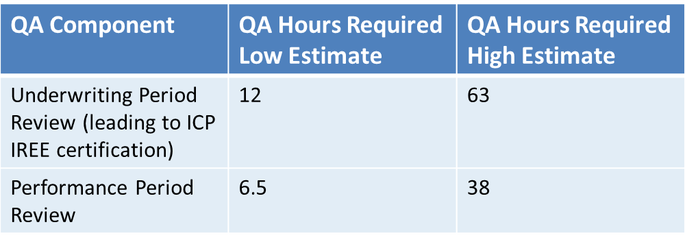
While the number of hours will always vary based on the size and complexity of the project, the results of this exercise suggest that to perform a complete review supporting ICP IREE™ certification will typically range from twelve to 63 hours of review time assuming that the project was initially developed in accordance with ICP by an experienced project developer.
Typically, the majority of these costs are already embedded into projects in the form of independent desktop reviews required by incentive and other programs or specified by savvy building owners and project developers. One of the goals of ICP is to have the full range of investors accept a project that has been certified and reviewed without the need for redundant process.
ICP believes strongly in the value of an independent review of documentation to ensure the quality of project fundamentals and the reliability of financial projections. The benefits of such a review are far greater than the costs, which make up a very small portion of most projects. One of the primary goals of ICP is to ensure that structured reviews by trained experts on standardized projects done once and done right, will result in more economical process and lower transaction costs. We are working with credentialed project developers, software providers, and QA providers to optimize this workflow and encourage all stakeholders to contact us to get involved.
For those interested in viewing detailed results of this effort, the QA Task Estimate Spreadsheet is available online.
Typically, the majority of these costs are already embedded into projects in the form of independent desktop reviews required by incentive and other programs or specified by savvy building owners and project developers. One of the goals of ICP is to have the full range of investors accept a project that has been certified and reviewed without the need for redundant process.
ICP believes strongly in the value of an independent review of documentation to ensure the quality of project fundamentals and the reliability of financial projections. The benefits of such a review are far greater than the costs, which make up a very small portion of most projects. One of the primary goals of ICP is to ensure that structured reviews by trained experts on standardized projects done once and done right, will result in more economical process and lower transaction costs. We are working with credentialed project developers, software providers, and QA providers to optimize this workflow and encourage all stakeholders to contact us to get involved.
For those interested in viewing detailed results of this effort, the QA Task Estimate Spreadsheet is available online.
 RSS Feed