
ICP
  • About
    • ICP for Programs, Financiers, and Green Banks >
      • GHG Accounting
      • Adaptive Reuse
      • Certification Timing
      • Post-Cert Changes
    • How Does ICP Work? >
      • Project Framework
      • Roadmap to IREE Certification
    • GGRF EPA Reporter
    • Tech Forum >
      • Technical Forum Blog
      • Discussion Notes
      • Call Recordings
      • Reference Documents
      • Glossary
      • Acronyms
      • Protocol Archives
    • ICP in Canada
    • Contact Us
  • Training
  • IREE Certification
    • Guide to IREE Certification
    • Commercial Protocols >
      • Large Commercial
      • Standard Commercial
      • Targeted Commercial
      • Basic / Performance
    • Multifamily Protocols >
      • Large Multifamily
      • Standard Multifamily
      • Targeted Multifamily
      • Basic / Performance
    • Project Development Specification
    • Project Registration >
      • Performance Update
    • Tools and Templates >
      • Cx, O&M, M&V Templates
      • QA Checklists
      • Building Button
    • Case Studies
  • Providers
    • Project Developer Network >
      • Join the ICP PD Network
    • Quality Assurance Assessors >
      • Join ICP's Quality Assurance Asserssors
  • Blog
    • Blog
    • ICP In the News

NEW RELEASE: ICP Quality Assurance System

3/31/2015

Comments

 
Picture
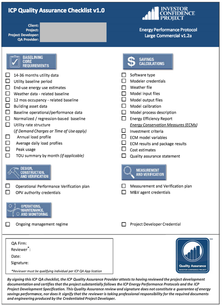
The Investor Confidence Project (ICP) is pleased to announce the launch of the ICP Quality Assurance Provider Credential, ICP Quality Assurance Checklists, and the ICP Quality Assurance Specification. This is the final major component of the Investor Ready Energy Efficiency™ certification system which is poised to increase investor confidence.

The energy efficiency industry has always been hampered by the inability for investors, especially the building owner, to be able to “bank” on predicted project returns that have been verified for authenticity by independent parties.  Currently, the calculation of potential savings are controlled by the developers and due diligence activities to verify them by third parties are typically skipped due to the time and cost required to re-engineer one-off projects with disparate engineering methodologies and documentation.  In the commercial sector, this issue has been one of several issues which have severely inhibited the realization of the vast potential for energy savings and associated financial gains.

The Investor Confidence Project (ICP) has been laying the groundwork for a transformation of how the industry operates.  The first step was the development of the ICP protocols by industry leaders that provide a roadmap for developers to incorporate standardized engineering and documentation.  The next step was the introduction of a program to train and qualify Credentialed Project Developers with the experience and expertise necessary to develop quality ICP compliant projects.  Today, ICP announces the launch of its Credentialed Quality Assurance (QA) Provider program which facilitates the vital and neglected step of verification of project fundamentals by independent third parties.  The new program is the final piece of the ICP System which now allows projects that pass review to be certified as ICP Investor Ready Energy Efficiency™.  These projects bring investor and building owners a new level of confidence in the engineering principles, underlying assumptions and especially the predicted financial yields of projects.
Picture
Today this means that building owners and investors now more economically employ an industry developed a methodology to achieve consistent due diligence results when evaluating projects.  Perhaps more importantly, tomorrow this development will enable a combination of programs, software, and integrated engineering reviews to drastically reduce the time and costs associated with underwriting projects.  Instead of multiple iterations of time consuming manual engineering efforts - soon a  click of a button will analyze the underlying engineering, calculations, and assumptions of projects against data-driven benchmarks and other criteria to flag areas that require additional scrutiny.  This automation of the technical review process will be further enhanced by integration  with public programs, utilities, and investors  ICP is already working with its Credentialed Software Providers, as well as key utility and regional programs, to bring this concept to reality.  The integration of automation, the ICP system, and engineering review will ultimately provide the scale to develop a verifiable asset class of Investor Ready Energy Efficiency™ projects that will be key to enabling secondary markets and securitization for the energy efficiency sector.

Picture
The commercial energy efficiency industry has been  perched on a tipping point to see a significant increase in deal flow.  The current combination of software automation, financial innovation such as PACE and Green Banks, and standardization through ICP’s Investor Ready Energy Efficiency™ holds promise to usher in a new era that will finally realize the massive potential energy savings and economic profits of the commercial energy efficiency sector.

Picture
Comments

Europe’s Investor Confidence Project Gets Serious

3/14/2015

Comments

 
PictureBy: Panama Bartholomy, Director of ICP Europe
The European Commission is putting its weight behind an initiative designed to increase private investment in energy efficiency, the Investor Confidence Project (ICP). ICP is accelerating the development of a global energy efficiency market by standardizing how energy efficiency projects are developed and energy savings are calculated.

In late February, the European Commission released a landmark report on energy efficiency in Europe that was 18 months in the making, and it had ICP all over it. The report, Energy Efficiency – the first fuel for the EU Economy, was issued by the Energy Efficiency Financial Institutions Group (EEFIG), a group of financial and energy efficiency leaders and building owners convened by the European Commission and United Nations Environment Programme Finance Initiative.

Earlier that same month, the European Commission awarded a €1.92 million grant to the European version of the project, ICP Europe. The grant will pay for a consortium of companies to:
  • Develop ICP’s project protocols for the European market;
  • Work with financial institutions to embed them into their financing process; and
  • Organize National Steering Groups in five countries: (Austria, Bulgaria, Germany, Portugal and the U.K.) to take the protocols to markets in those countries.

To cap it off, the European Commission’s main energy website unveiled a new
Financing Energy Efficiency web page that listed ICP Europe as a recommended initiative; it was the only initiative listed not related to the European Commission.

We get it! We feel loved and trust us, it’s mutual.

Introduced in November 2014, Environmental Defense Fund’s ICP Europe has been gaining momentum among the European public and private sectors, and financial and engineering communities have recognized the need for the type of standardization offered by our Energy Project Protocols and professional credentialing system.

EEFIG (not an exotic Mediterranean fruit)

Comprised of more than 200 individuals from over 100 organizations, including Deutsche Bank, ING, Allianz, BNP Paribas, the European Property Federation, and EuroACE, EEFIG highlighted ICP six times in their report, calling us a “model initiative” and recommending that Europe develop a “standardization and performance tracking initiative (e.g. building on the Investor Confidence project) that supports the development of standard processes and open-sourced buildings energy usage database.”

EEFIG surveyed members of the group to identify the major drivers of energy efficiency finance supply and demand, and the survey showed standardization as the top driver for both supply and demand of finance, an issue at the heart of ICP’s efforts.

EEFIG also identified other drivers that are directly being addressed by ICP Europe, including “increased investor confidence and change in risk perception, transaction costs/ simplicity, measurement, reporting and verification and quality assurance, lender's approach to risk assessment, risk-return targets, availability of data, price of energy and the challenge of aggregating projects.” The ICP protocols and process provide clear pathways for developers, building owners and investors to address these exact issues.

Europe-specific protocols on the way

The EEFIG report went beyond identifying barriers to investment by offering a series of recommendations to government authorities and market players. The development of a European ICP was recommended as a specific “to-do” a number of times in the following sections: “Strong, Stable and Well-enforced Regulatory Framework,” “Clear Business Case, Leadership and Awareness at Key Decision Maker Level,” “Standardization,” “Development of Easy-to-Use Standards for All Steps in EE Investment Process.”

The ICP Europe team will be working with members of EEFIG to implement the report’s recommendations by developing Europe-specific energy efficiency protocols, starting this May and working with EFFIG members to embed those protocols in building energy renovation programs around the European market.

For more information on ICP Europe, including how to take part in developing protocols and other tools, visit www.EEperformance.org/europe.

Comments

ICP Technical Lead Becomes Chair of EVO IPMVP Technical Committee

3/13/2015

Comments

 
Picture
The Investor Confidence Project wants to congratulate Tracy Phillips, who has been our fearless technical lead for the last three years, on his new position as Chair of the Efficiency Valuation Organization (EVO) International Performance Measurement and Verification Protocol (IPMVP) Technical Committee. The Investor Confidence Project has long leveraged IPMVP as the core of our measurement approach, and this will serve to bring the organizations closer in the coming years. We always knew Tracy was good, but this proves it.

After serving on the IPMVP Technical Committee for the past seven years, Tracy Phillips will now Chair the IPMVP Committee, which is EVO's authority on the state of the art in M&V. It is responsible for all EVO publication, training and examination materials in the field. It also maintains awareness of the relevant work of others and places such in the Subscriber or Public libraries of EVO's website, in accordance with Board policy.

The committee is currently focusing on the development of the new IPMVP Core, which will replace the current version of IPMVP Volume I later this year. Tracy is also currently involved with revisions to the exam used to Certify Measurement and Verification Professionals (CMVP), and the development of Measurement and Verification Plan templates that will be made available to the public. 

Congratulations Tracy and good move EVO.

Comments

California's Energy Efficiency Action Plan Highlights ICP

3/11/2015

Comments

 
Picture
Assembly Bill 758 (Skinner, Chapter 470, Statutes 2009) requires the Energy Commission, in collaboration with the California Public Utilities Commission and stakeholders, to develop a comprehensive program to achieve greater energy efficiency in the state’s existing buildings.

The Energy Commission foresees implementing AB 758 in three phases. The first phase began with the American Recovery and Reinvestment Act of 2009 (ARRA) implementation period (2010-2012). The Energy Commission’s ARRA-funded pilots supported energy efficiency efforts through state and local upgrade programs, workforce training, and financing. 

ICP is very pleased to have been included in the newly released California’s Existing Buildings Energy Efficiency Action Plan that lays out a course forward for California to achieve the great potential of energy efficiency in existing buildings.
Picture

Picture
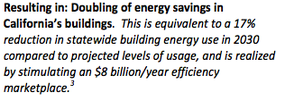
Efficiency is first in the loading order for energy investment because it is cheaper than expanding electric and gas supplies. Reaching the policy goal for building energy efficiency upgrades is estimated to require investment of at least $ 8 billion per year, with private capital accounting for the majority.126 Currently, $1.4 billion a year is spent by utility ratepayer incentive funds and building owner investments. This amount is not sufficient to achieve California’s energy and climate goals, and means that solutions must leverage private capital. 

Therefore, state agencies must adopt policies and support actions that will catalyze the private market. Current finance products used for efficiency are primarily one‐off, unsecured loans with short terms and high interest. Efficiency is not typically incorporated into long‐term mortgage debt. New long-term finance programs are needed that match cash flow benefits with lower risk‐informed interest rates based on robust data from loan repayment histories of large portfolios of efficiency‐specific transactions. Essentially, efficiency needs the kinds of finance programs that the solar industry has created.  
The investment community has emphasized that to invest in energy efficiency project finance they need more project standardization, and reliable financial and energy performance data. The Environmental Defense Fund sponsors the Investor Confidence Project (ICP) to address these needs. The standardization facilitated by the ICP is the first step in creating an asset class of energy renovation projects that can attract large scale capital.  The ICP is being considered in New York, Texas, Connecticut, Europe, and California, as part of Commercial PACE, benchmarking, and utility finance programs. As California increases commercial and multifamily retrofit programs, the ICP represents a best practice that can align efforts and help establish a consistent statewide market for energy efficiency project finance.
Picture

AB 758 is proposed to achieve in 3 stages: 

Phase 1: Infrastructure Development & Implementation Plan

The California Energy Commission gathered relevant lessons learned from ARRA, researching market conditions, and working with technical support consultants to develop an understanding of the market. This Scoping Report is the result of this overall research effort and is intended to be a high-level summary of major gaps and needs in the marketplace. 

The newly released California’s Existing Buildings Energy Efficiency Action Plan defines major goals and strategies of the AB 758 program, articulate solutions for addressing needs identified in the Scoping Report, and develop a roadmap for implementation of the program

Phase 2: Market Development & Partnerships

Phase II of the program will involve implementation of the near-term activities identified in the Action Plan, including any necessary market development to support energy efficiency programs (for example, tools, workforce development, additional market analysis, etc.) A major activity in this phase will be identifying industry and agency partners and defining and developing collaborative relationships.

Phase 3: Statewide Ratings & Upgrades Requirements

This third phase of the program will help transition voluntary program approaches and market maturity into regulations when and where identified as appropriate to accomplish the goals of the AB 758 program.
Comments

ICP Europe Recieves European Commission Grant

3/5/2015

Comments

 
Picture
A move to accelerate energy efficiency and cut carbon emissions from commercial buildings is gaining momentum in Europe, with the European Commission granting €1.9 million to fund an initiative aimed at mobilizing private capital for energy efficiency practices across Europe.

At the same time, a group of energy efficiency industry stakeholders convened by the European Commission and United Nations Environment Programme Finance Initiative called for Europe to embrace the tools and resources included in the initiative as “best practices.”

The Investor Confidence Project Europe (ICP Europe), created by the Environmental Defense Fund, works with the financial and efficiency sectors to remove barriers to investment in energy efficiency by providing tools and guidance that standardise the process of renovating a building. The European Commission is providing the grant to ICP Europe through its landmark research and innovation programme, Horizon 2020.
 
“The European Commission has made clear it sees the lack of standardisation in energy renovation projects as a hindrance to scaling investment in energy efficiency,” said Panama Bartholomy, Director, Investor Confidence Project Europe. “Thanks to this generous grant, ICP Europe can help to significantly increase investment in European energy efficiency.”

Convened by the European Commission and United Nations Environment Programme Finance Initiative to study barriers to energy efficiency finance, Energy Efficiency Financial Institutions Group (EEFIG) last week released its Energy Efficiency – the first fuel for the EU economy report, referring to ICP Europe as a best practice and needed solution. The ICP Europe team will be working with financial institutions, asset management firms, engineers, and government officials from EEFIG to implement the report’s recommendations, both Europe-wide and at the member state level.

Announced in November 2014, ICP Europe aims to boost private capital investment in European energy efficiency renovation projects to help Europe meet its goal of reducing carbon emissions from buildings by 90% by 2050. Estimates project that large-scale European energy efficiency efforts could reduce carbon emissions by 932 million metric tons, equivalent to taking nearly 200 million cars off the road, and creating more than two million jobs in the building industry by 2020.

For more information on the Investor Confidence Project Europe and to participate in this initiative, visit www.EEperformance.org/europe.

Comments

    RSS Feed

    Archives

    April 2025
    November 2024
    May 2024
    July 2023
    July 2021
    June 2019
    March 2019
    March 2018
    January 2018
    December 2017
    October 2017
    August 2017
    January 2017
    December 2016
    October 2016
    August 2016
    July 2016
    June 2016
    April 2016
    March 2016
    February 2016
    January 2016
    December 2015
    November 2015
    October 2015
    September 2015
    August 2015
    July 2015
    June 2015
    April 2015
    March 2015
    February 2015
    December 2014
    November 2014
    October 2014
    September 2014
    July 2014
    June 2014
    May 2014
    April 2014
    March 2014
    February 2014
    January 2014
    December 2013
    November 2013
    October 2013
    September 2013
    August 2013
    July 2013
    June 2013
    May 2013
    March 2013
    January 2013
    December 2012
    October 2012

    Categories

    All
    179d
    25e
    Ab758
    Benchmarking
    California Energy Commission
    Carbon Credit
    Cec
    Credentialing
    Edf
    Eepp
    Energy Software
    Femp
    Icp
    Insurance
    Leasing
    Low Income Weatherization
    Measurement And Verification
    M&V
    Pace
    Performance
    Ppa
    Risk Management
    Software
    Software Providers
    Solar
    Tax Credits
    Ump
    Uniform Methods Project
    Wap

Contact the Project