
ICP
  • About
    • ICP for Programs, Financiers, and Green Banks >
      • GHG Accounting
      • Adaptive Reuse
      • Certification Timing
      • Post-Cert Changes
    • How Does ICP Work? >
      • Project Framework
      • Roadmap to IREE Certification
    • GGRF EPA Reporter
    • Tech Forum >
      • Technical Forum Blog
      • Discussion Notes
      • Call Recordings
      • Reference Documents
      • Glossary
      • Acronyms
      • Protocol Archives
    • ICP in Canada
    • Contact Us
  • Training
  • IREE Certification
    • Guide to IREE Certification
    • Commercial Protocols >
      • Large Commercial
      • Standard Commercial
      • Targeted Commercial
      • Basic / Performance
    • Multifamily Protocols >
      • Large Multifamily
      • Standard Multifamily
      • Targeted Multifamily
      • Basic / Performance
    • Project Development Specification
    • Project Registration >
      • Performance Update
    • Tools and Templates >
      • Cx, O&M, M&V Templates
      • QA Checklists
      • Building Button
    • Case Studies
  • Providers
    • Project Developer Network >
      • Join the ICP PD Network
    • Quality Assurance Assessors >
      • Join ICP's Quality Assurance Asserssors
  • Blog
    • Blog
    • ICP In the News

ICP Data Spec: Getting Into the Weeds

5/19/2016

Comments

 
Picture
The ICP team hosted the first of six bi-weekly technical forum calls on May 18th to discuss the development of the ICP Data Specification, a joint effort between LBNL and ICP using the Building Energy Data Exchange Specification (BEDES) as a backbone to the Data Spec. 
Premise: EE Investors will demand volumes of normalized data via the standardized ICP protocols to increase confidence in results.
Goal: Specification for a standard dataset for ICP protocols, based on the DOE BEDES:
  • Will allow for data to be easily exchanged from project developers to a wide range of investors
  • Standard data specification can lead to reliable actuarial data on EE performance
The Data Spec will address three use-cases, specifically:
  • Engineering review by independent Quality Assurance Providers
  • ICP registry actuarial analysis - project types, project data, savings, realization rates, variations in savings
  • Underwriting review - assessing the financial / economic performance of projects, and key underwriting metrics
The lively discussion, with participating stakeholders and data enthusiast from the US and abroad, dove into the weeds and discussed the specific data fields in the Project Overview and Baselining sections of the Data Spec Strawman. The next call is scheduled for June 1st at noon EST, and will focus on Savings Calculations. 
If you'd like to join the next call, reach out to Jeff Milum at  jeff.milum@efficiency.org for detalls. 
DATA DATA DATA!


Comments

NEW TRAINING SCHEDULED: ICP Credentialed Project Developer

5/17/2016

Comments

 
Picture
The Investor Confidence Project (ICP) will be hosting its next two Project Developer training workshops on May 26th at 3 pm EST and June 30th at 1 pm EST. 
The ICP System leverages existing professional certifications, credentialed providers, and the ICP protocols to create Investor Ready Energy Efficiency™ projects that increase investor and building owner confidence in project engineering fundamentals and financial returns.  
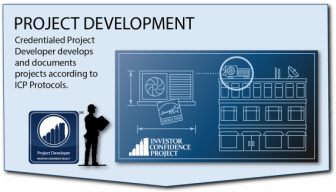
The ICP Project Developer Credentialing program represent the core of ICP’s deployment system. This program ensures that select energy efficiency project developer professionals have the necessary qualifications and ICP training to develop projects that utilize industry best practices and conform to the ICP standards.
For qualified project developers, joining the ICP credential program involves submitting a brief application and participating in this free two hour web-based ICP training course that covers best practices and methods for incorporating the ICP Protocols into your project origination process.
​You can register for these events at our website.

Comments

ICP March Technical Forum - Targeted Protocol

3/31/2016

Comments

 
The ICP Technical Forum was held on March 31st, 2016. The group reviewed proposed changes to the Targeted Commercial and Multifamily Protocols. The following are highlights from the conversation. To hear the entire forum conversation, visit this LINK.
​Highlights:
  • Added protocol summary table to introduction (provides a quick overview of protocol requirements in a single table)
    • Agreed that this is a good addition; and will be best if we can format so that the table fits on one page.
  • Updated the introduction to reflect the current state of ICP – PDS, credentialing program, IREE, Project Registry.
  • Split all sections into Underwriting and Performance Period requirements, as appropriate.
    • Agreed that this helps to distinguish between requirements during different phases of project development.
  • Removed whole building energy baseline requirement (now optional), and end use energy use estimates (also now optional).
    • This whole-building baselining approach may still be appropriate for some Targeted projects. Making this optional will allow projects to utilize this approach, and potentially apply an Option C M&V approach for projects or programs that require / warrant this approach.
  • Using a targeted “retrofit isolation” approach, which supports M&V Options A and B directly
    • Added discussion of measurement boundary, and added discussion of measured and estimated parameters. Agreed that focusing on this retrofit isolation approach, rather than a whole-building baseline approach, makes sense for many Targeted projects, and directly supports an M&V Option A and/or B approach.
  • Cost estimates: now say must “consider” all of these components, rather than must “include.”
    • Agreed that the “softer” language still points out key items to consider. But simpler measures may only require application of some of these cost components.
  • OM&M: Operator’s Manual is optional.
    • Again, simpler projects or measures may not warrant updates to the Operator’s Manual, or creation of an Operator’s Manual if one does not exist.
  • M&V: Added Option C M&V approach as optional.
    • Larger “targeted” projects or projects with greater savings can take advantage of an Option C M&V approach.
  • M&V: Added Option C “portfolio approach” to optional.
    • More like spot checking some projects in a larger portfolio (so apply Option C to screen buildings, then apply Option A or B if there are poor performers, or questions.) Data driven approach to warrant Option A and B. Gross savings adjusted for weather, and if within a certain threshold, do not need to do Option A/B M&V. This topic requires additional discussion.
  • Updated references (IPMVP Core Concepts, new versions of AHSRAE documents).
  • Added QA Checklist to “sign off” page.
  • Optional items: need to look at language in the protocols to make sure the role of the QA provider is clear, and they need to help to arbitrate, and represent the “spirit” of the protocols (especially since many items are optional under Targeted, and therefore subject to being ignored).
  • Allow proprietary closed book calculations?
    • Keep it in, but requires more discussion – Can say something like closed-book proprietary tools “are discouraged,” because it makes it difficult to certify a project. Needs to be well documented and demonstrated ability to prove unbiased results. Onus is on the QA provider to validate use of these tools. 
Comments

Upcoming ICP Provider Credential Training

3/23/2016

Comments

 
The ranks of Investor Confidence Project credentialed providers continues to grow, and ICP is looking for additional qualified project developers and quality assurance (QA) providers.  ICP is hosting upcoming virtual training events for interested parties who wish to become ICP credentialed providers.
​
  • The next Project Developer Credential training will be held on March 24th at 10amPDT/1pmEDT.  Please register to attend.

  • The next Quality Assurance Provider Credential training will be held on April 7th at 11amPDT/2pmEDT.  Please inquire about the program to attend the training. (Attendance at the Project Developer training is a prerequisite to this QA Provider training).

If you have any questions about which program is right for your organization, or how to participate in the Investor Confidence Project, please contact us to discuss.

Comments

ASHRAE Standard 211P

12/10/2015

Comments

 
Picture
ASHRAE has released its proposed ASHRAE/ACCA Standards for Energy Audits, which is currently receiving public comments until January 4th, 2016. While the ICP does not specify how energy audits need to be performed, the ICP Project Developer Specification does provide guidance on energy audits, and refers the the ASHRAE/ACCA Standard 211P, Standard for Commercial Building Energy Audits as best practice, as well as the ASTM E2797-11 Building Energy Performance Assessment (BEPA) standard.
Standard 211P will establish consistent practices for conducting and reporting energy audits for commercial buildings. The standard will define the procedures required to perform Energy Audits Levels 1, 2 and 3; provide a common scope of work for these audit levels for use by building owners and others; establish standardized industry practices ; and establish minimum reporting requirements for the results.
This standard represents an important step in the proper development of a robust energy effiiciency project. The ICP team invites our stakeholders to review this new Standard for Energy Audits, and provide comments to ASHRAE.

Comments

ICP Technical Forum Call - September 16th, 2015: Recap

9/16/2015

Comments

 
Picture
Today's ICP Technical Forum call provided a format to examine some procedures and documentation specified by the ICP Protocols which may not represent common business practices for some project developers.  The call was attended by over 30 participants, The following are highlights from the discussion:

Baselining - should non-normalized baselines be allowed for some projects?
  • Many programs require normalization of the baseline utility data to independent variables. This is standard practice for many energy efficiency projects as well, and typically involves normalization to weather data, although other independent variables may be more appropriate.
  • It is sometimes difficult to develop a correlation between building energy use and weather data, or  other independent variables. Developing an energy-use equation to appropriate variables can be challenging, and may involve more "art than science" in some cases. However, typically, a correlation between specific variables and energy use can be determined.
  •  Normalization of baseline data using spreadsheets is not overly complicated, and there are free applications available to assist with normalization. However, all cases require some skill on the part of the practitioner to develop a meaningful relationship between independent and dependent variables, even if the process is automated.
  • Weather normalization or normalization to any independent variables may not be appropriate for some projects. Even if the process is not complex, this could still be seen as "over-kill" for some project or measure types. Examples of measure in which this may not be necessary might include: pressure booster pumps, domestic hot water production, exterior lighting, process applications, etc.
  • At least for Targeted Protocol, suggest considering non-normalized baselines for projects or measure-types that can justify this approach. Care needs to be applied, however. Interior lighting, for example, affects heating and cooling loads as well. These interactive effects should be accounted for in a project's analysis, and these affect systems that are (commonly) weather-dependent. 
Savings Calculations - is their reluctance to share "live" spreadsheets between Project Developers and Quality Assurance Providers?
  • Many programs require that project developers share open, live spreadsheet calculations, so these can be thoroughly reviewed, regarding methodology, assumptions, etc. This is an important element of project development and review, and provides confidence between the investor and the project developer. Represents a key component to the underwriting process.
  • While project developers may be "protective" of their calculation tools, this is a very necessary element - an open book approach. NDAs are a common tool used to address concerns, and can be used between the quality assurance provider, investor, and project developer to help mitigate concerns.
Plans - is development of Operational Performance Verification (OPV, or commissioning), OM&M and M&V plans during the underwriting period a reasonable request? 
  • OPV, OM&M and M&V represent critical components that help ensure the success of an energy efficiency project. While OPV and OM&M plans are optional during the Underwriting period under the Targeted protocol, they are required under the Standard and Large protocols. 
  • The plans need to be as concise as possible, and focus on the measures involved with the project. (ICP's use of the term "Operational Performance Verification" in place of commissioning is intended to highlight this differentiation: commissioning practices applied only to the measures and system involved with the project, and not commissioning of the entire building).
  • The ICP team has developed templates for concise OPV plans and OM&M plans. These represent "living documents." They can be filled out during the underwriting process, before projects are well-defined or before a contract has been signed, with minimal effort (but still include project-specific details). And can be revised / added to as the project develops during construction and into the performance period.
  • All stakeholders are invited to review these documents (plan templates), and provide feedback, or use them for their ICP projects.
  • Similar efforts are being applied to develop M&V plan templates. The IPMVP committee is in the process of developing M&V Plan adherence criteria, and will share these with the community and use these to develop IPMVP-compliant M&V plan templates. Their efforts will be supported by the ICP team, to develop M&V plan templates for various Option types and measure / project types.
Miscellaneous
  • The NYSERDA Multifamily Performance Program (MPP) is currently performing a side-by-side comparison of the MPP and ICP requirements, to evaluate ICP requirements that enhance the MPP requirements, and evaluate the additional costs or resources associated with these items.
  • The ICP team is similarly working with Pilot Projects to evaluate the ICP required elements, and what resources are required to incorporate ICP protocols into best-practices.
The next Technical Forum call will be on October 15th at 1 pm EST. The call will involve a discussion of the ICP Quality Assurance process. Specifically, discussing the costs and efforts associated with performing reviews of documentation requirements and technical components of a project. Please join us!
-The ICP Team
Comments

ICP Technical Forum September 16th - A Discussion of Common Project Gaps

9/10/2015

Comments

 
Picture
On September 16th, at noon EST, the ICP Technical Forum will be focusing on current requirements of the ICP protocols that have presented some challenges to the "business-as-usual" approach to Energy Efficiency Project Development. Common items that have been brought up during the development of initial ICP-compliant projects, which will be discussed during this Technical Forum call, include:
  • Savings Calculations - sharing "live" spreadsheet calculations.
  • Operational Performance Verification (OPV, or commissioning) Plans - what is required in an OPV/Cx plan, and how elements of the plan need to be developed as the project progresses.
  • Operations, Maintenance and Monitoring Plans - what are appropriate methods to ensure persistence of savings, and what is needed in an OM&M plan.
  • Measurement and Verification Plans - what is required to demonstrate adherence to IPMVP criteria.
The Technical Forum call will also revisit the discussion  held during the August call, regarding normalization of baseline data, and whether non-normalized baselines can be developed for projects that warrant / justify this approach.
Please join us on September 16th, noon EST, to discuss these topics, and bring your own questions or concerns regarding challenges that the ICP approach might present for your projects and methods.

Comments

ICP Technical Forum Recap - Aug. 19, 2015

8/19/2015

Comments

 
Picture
On August 19th, 2015 at noon EST, the ICP team reconvened the ICP Technical Forum (a monthly 90-minute webinar and conference call), which had been on hiatus for the last four months as the ICP team focused on deploying the ICP Provider Credentials and IREE Project Certification. The call was well attended with 45 people logged into the session, and a lot of participation and great feedback from project developers and QA providers such as SCIenergy, AEA, Quest, TRC, NYSERDA, the CO Energy Office, NREL, NJ PACE, and NH PACE among others.  

Aug 19th 2015 - Tech Forum Recording
The call focused on some of the changes being proposed for the new version of the ICP Targeted protocol (which will extend once agreed to across the portfolio of protocols).  There was great input and a lot of agreement around underwriting and performance periods, and some modifications to the technical requirement around baselining in particular, as well as discussion regarding the new Project Registry and process around it..

Highlights from the call are presented below:
  • The ICP Underwriting Phase focuses on requirements regarding baseline development, savings calculations, and the development of the OPV (Cx), OM&M and M&V plans.
  1. Plans need to be developed, at least a high level, for all three of these components. This can be particularly important to M&V to ensure that proper pre-retrofit data are collected, and savings estimates or energy models are properly calibrated.. 
  2. The plans can be "living documents," in the sense that further development can and will need to be performed to reflect the final construction.
  3. If templates are developed for these plans (which the ICP team is currently developing), then the cost to develop plans for a specific project should be minimized.
  • The ICP requires development of a baseline using ASTM BEPA methods and a regression-based analysis approach. However, many projects to date use a simpler "data only" approach, without any regression applied. Should the ICP allow for non-regression-based baseline development approaches?
  1. Use of as-is utility data to develop the baseline can be problematic, and can over- or under-estimate energy savings projections. Normalizing the data to weather, or other routine adjustments, is critical.
  2. A baseline should be developed for the entire building for every project, even Targeted projects that may only have a single or a handful of measures. The baseline provides a valuable reference and check against savings projects, and is required by most programs or financial organizations.
  • Should ICP address the idea of using one form of M&V for the first few years of the reporting / performance period (say Options A and/or B), and then using a different approach (Option C) for subsequent years, to reduce costs / effort?
  1. Very few projects employ this method to date. However, the approach could reduce costs related to M&V if savings are being illustrated during the first few years of the performance period. As long as no significant non-routine adjustments are encountered while Option C is being applied.
  2. If savings are not being realized during the Option C M&V period, then the Option A/B approaches (or a targeted recommissioning or operational performance verification approach) could be redeployed, to further identify the issue(s). 
  • ICP is in the process of launching its Project Registry, which will record project seeking IREE designation.
  1. Use of the Project Registry by projects seeking IREE should be mandatory.
  2. The user could be asked for permission to release information to specific individuals, allowing it to serve as a platform to exchange project information.
  3. Whether the building is owner-occupied or leased should be added to the form, as well as EPC as a financing mechanism, and water as a measure type.
  4. The savings summary table should specify required points (ECM name / brief description, energy savings, cost savings, implementation costs. Simpler is better.
  5. Potentially align the data platform / requirements with other benchmarking tools.

Please join us for our next ICP technical Forum call on September 16th at noon EST. And send any additional thoughts or contributions to Tracy Phillips, ICP Technical Lead, at [email protected].
Comments

ICP Technical Forum - August 19th, 2015

8/18/2015

Comments

 
Allies, credentialed providers, technical forum members, and other friends of the Investor Confidence Project (ICP),

This is a reminder that we will be hosting an Investor Confidence Project Technical Forum Meeting tomorrow at August 19th (9am Pacific / 12pm Eastern) 

This meeting will focus on proposed changes to the ICP Energy Performance Protocols and review of ICP Data strategy.  Complete details can be found in the agenda which we recommend all participants review prior to the meeting. 

This will be a virtual meeting with a web based presentation (https://join.me/investorconfidenceproject) and conference line (1.415.655.0381  /  Access Code 830-557-067#).  

As a reminder we also have another upcoming technical forum roundtable to discuss and strategize on the costs associated with developing certified Investor Ready Energy Efficiency (ICP compliant) projects on September 16th (9am Pacific / 12pm Eastern).

Thanks again for your support of ICP!
The ICP Team.
Comments

Join the Growing List of Credentialed Project Developers!

8/3/2015

Comments

 
Picture
The Investor Confidence Project  (ICP) has two upcoming training sessions for its Credentialed Project Developer program on August 6th and September 17th (both at 10 am Pacific).  ICP is seeking additional candidates to join its growing list of Credentialed Project Developers which includes Association for Energy Affordability, Environmental Building Strategies, H.T. Lyons, Johnson Controls, L&S Systems, Pepco Energy Services, Performance Systems Development, Swinerton Builders, Trane, TRC Energy Services and others. Credentialed project developers enjoy enhanced credibility, additional brand awareness, and preferred status with an increasing number of programs including San Francisco’s Department of the Environment and others. ICP is expanding its regional programs and is in the process of rolling out programs in New York, New Jersey, Connecticut, Texas, and Southern California who are partnering with ICP to increase deal flow and ensure the success of participating projects.  Joining the ICP credential program involves meeting the program's requirements, submitting a brief application and participating in a two hour web-based ICP training course that covers best practices and methods for incorporating the ICP Protocols into your project origination process.  

If you are not familiar with ICP, the ICP System leverages existing professional certifications, credentialed providers, and the ICP protocols to create Investor Ready Energy EfficiencyTM projects that increase investor and building owner confidence in project engineering fundamentals and financial returns.  The new ICP Project Developer Credential program represents the core of ICP’s credentialing deployment strategy.  This program ensures that select project developers have the necessary qualifications and ICP training to develop projects that utilize industry best practices and conform to the ICP standards.

Registration is open, and if you have any questions or an interest in learning more please reply to this email or contact [email protected] to learn more.


Comments
<<Previous

    Follow Tech Forum Blog:


    Curated by:

    Tracy Phillips
    ICP Technical Lead


    Archives

    May 2016
    March 2016
    December 2015
    September 2015
    August 2015
    April 2015
    February 2015
    January 2015
    December 2014
    October 2014
    August 2014
    July 2014
    June 2014
    May 2014
    April 2014
    March 2014
    February 2014

    Categories

    All
    Data Access And Management
    Large Commercial
    Quality Assurance
    Standard Commercial

    RSS Feed

Contact the Project