ICP
  • About
    • ICP for Programs, Financiers, and Green Banks >
      • GHG Accounting
      • Adaptive Reuse
      • Certification Timing
      • Post-Cert Changes
    • How Does ICP Work? >
      • Project Framework
      • Roadmap to IREE Certification
    • GGRF EPA Reporter
    • Tech Forum >
      • Technical Forum Blog
      • Discussion Notes
      • Call Recordings
      • Reference Documents
      • Glossary
      • Acronyms
      • Protocol Archives
    • ICP in Canada
    • Contact Us
  • Training
  • IREE Certification
    • Guide to IREE Certification
    • Commercial Protocols >
      • Large Commercial
      • Standard Commercial
      • Targeted Commercial
      • Basic / Performance
    • Multifamily Protocols >
      • Large Multifamily
      • Standard Multifamily
      • Targeted Multifamily
      • Basic / Performance
    • Project Development Specification
    • Project Registration >
      • Performance Update
    • Tools and Templates >
      • Cx, O&M, M&V Templates
      • QA Checklists
      • Building Button
    • Case Studies
  • Providers
    • Project Developer Network >
      • Join the ICP PD Network
    • Quality Assurance Assessors >
      • Join ICP's Quality Assurance Asserssors
  • Blog
    • Blog
    • ICP In the News

Targeted Commercial Protocol

Energy Performance Protocol - Targeted Commercial 1.0a (EPP-TC)

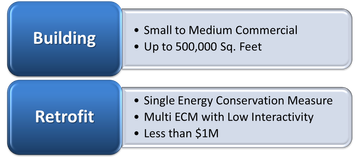
The Energy Performance Protocol for Targeted Commercial (EPP-TC) is designed for projects that involve individual or smaller sets of energy conservation measures (ECM) that focus on only one or a handful of building end-uses, such as lighting, controls, HVAC replacement, etc. EEP-TC makes allowances for alternative and simplified approaches to technical underwriting and engineering, providing a standardized framework that is scaled for energy efficiency projects with less complexity and financial risk.

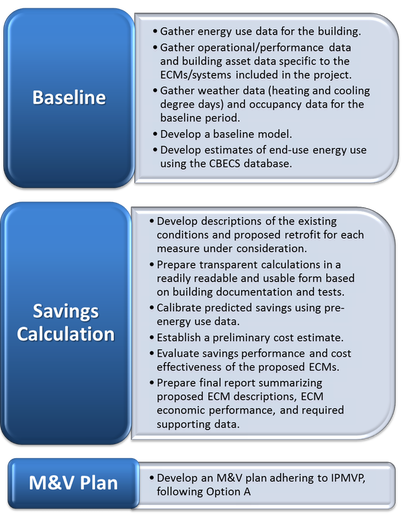
These targeted projects typically affect only a portion of the building’s end-uses, and have greater budget constraints, such that requirements for baselining, savings projection, commissioning, and measurement and verification, must be targeted and streamlined. While important to the project’s development and success, these components must be scaled appropriately, such that their inclusion in these targeted projects do not overly burden the project budget.

The ICP Energy Performance Protocol for Targeted Commercial makes allowances for alternative and /or targeted approaches with respect to the balance of technical rigor and risk, providing a standardized framework for energy efficiency projects with less complexity or financial constraints while continue to provide standards and consistency.
Picture
Core Requirements of ICP Targeted Commercial Protocol:
Picture
Your browser does not support viewing this document. Click here to download the document.
energy_performance_protocol_-_targeted_commercial_v1.0a.pdf
File Size: 990 kb
File Type: pdf
Download File


The Energy Performance Protocols are intended as base minimum requirements for an investment quality analysis and best practices to maintain, measure and verify the energy savings, not an exhaustive treatment of all possible techniques. Each section of the document establishes these minimum requirements and offers additional methods and tools that can be used to improve the reliability of savings estimation and measurement. Until the protocols have been applied and testedsufficient performance data exist for projects following the ICP Protocols, it is not possible to gauge the magnitude of the impact of these additional processes and tools on the confidence interval around savings projection. A checklist provided as part of this document is intended for inclusion in project documents.  Providers are asked to self-certify that they have fulfilled the requirements listed and to indicate what additional methods they applied.

This document will evolve over time. Some methods may move from an “additional” or “recommended” category to a standard requirement. Others may prove insignificant for accuracy of projections relative to the time and effort they require. A scoring system may also be introduced to weigh t the importance of different components and provide an overall investment confidence score for potential energy efficiency projects. Members of the ICP invite engineers, building owners, software developers, prospective lenders and investors, and others to participate in testing and improving these protocols by applying them to retrofit projects and sharing their results.  

Contact the Project